Water filtration is one of the few consumer categories with a genuinely authoritative shorthand: NSF/ANSI certification. Standard 58 covers reverse osmosis systems, 42 covers taste and chlorine, 53 covers health-related contaminants such as lead, and 401 covers emerging compounds. A filter tested to those standards has had its claims independently verified. One that has not is asking you to take its word.
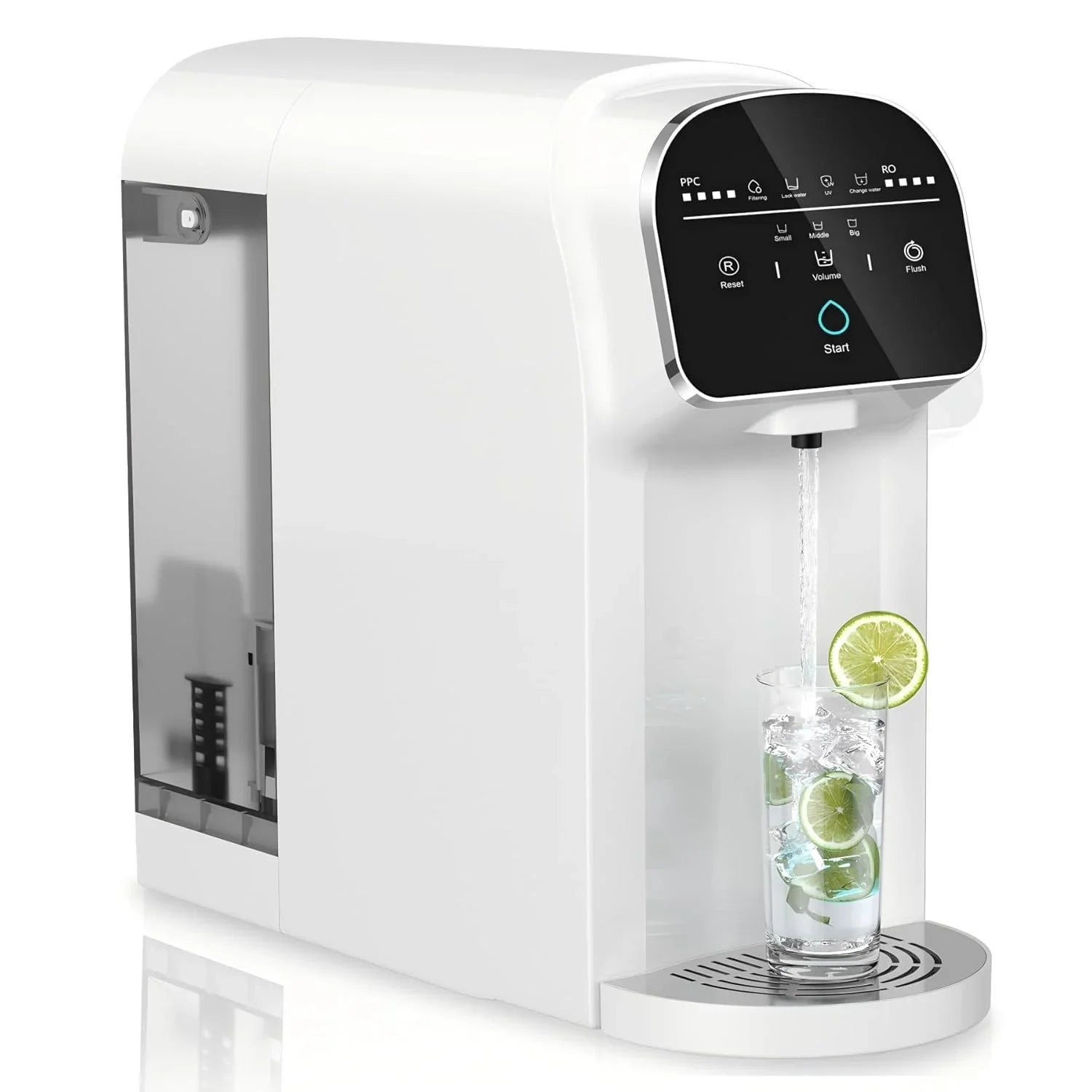
The Aigerri Countertop RO Water Filter costs $399.99 and makes a broad set of claims — removes heavy metals, bacteria and viruses, adds minerals back, wastes 80% less water. No certification is cited anywhere. There is also a number on the page that deserves a closer look.

The specification, as listed
| Product | Aigerri Countertop RO Water Filter with UV |
|---|---|
| Price | $399.99 |
| Filtration | Multi-stage RO plus UV sterilisation |
| Minerals | Reintroduced after filtration |
| Tanks | 5 L raw water, 2 L purified |
| Output rate | About 1.8 cups per minute |
| Water efficiency | Stated 5:1 pure-to-waste; "80% less water than traditional units" |
| Installation | None — no drilling, no plumbing |
| Included | 2 replacement filters |
| Filter life | 6–12 months, with a change alert |
| Replacements | PPC $39.99 · RO $49.99 · set $89.98 |
| Certification | None stated |
About that 5:1 ratio
Reverse osmosis works by pushing water through a membrane fine enough to reject dissolved solids. Whatever does not pass through leaves as concentrated waste. The efficiency of a system is normally expressed as a ratio, and here is where the listing needs clarifying.
Conventionally, RO ratios are quoted as waste to pure — a typical countertop unit might be 2:1 or 3:1, meaning two or three litres discarded for every litre produced. Aigerri states 5:1 pure-to-waste, which reversed the usual order means five litres produced for every one discarded, or roughly 83% recovery.
If that is accurate, it is genuinely exceptional — well beyond what most domestic RO achieves, and it would be the headline feature of the product rather than the fifth bullet point. If the ratio has been written the wrong way round and it is actually five litres wasted per litre produced, that would be poor even by countertop standards. The separate claim of "80% less water than traditional units" is consistent with the favourable reading, but it is a comparative marketing statement rather than a specification.
This is worth one email before you buy. Ask Aigerri to state the recovery rate as a percentage — that phrasing has no ambiguity.
What the design gets right
Countertop RO with no plumbing is a real solution
Under-sink RO means drilling the worktop for a faucet, tapping the cold supply, and connecting a drain line — work most renters cannot do and many owners would rather not. A tank-fed countertop unit removes all of it. For rentals, dormitories, offices and anyone who moves often, this is the format that makes RO accessible at all.
Remineralisation is the correct follow-up to RO
Reverse osmosis is indiscriminate: it strips calcium and magnesium along with everything else, which is why unremineralised RO water tastes flat. Adding a mineral stage afterwards is standard practice on good systems and materially improves the taste. Aigerri including it rather than selling it as an upgrade is the right call.
A 5 litre raw tank is usefully large
Small countertop units with 1 to 2 litre input tanks need refilling constantly. Five litres of input feeding a 2 litre purified reservoir is a sensible ratio for a household, and 1.8 cups per minute fills that reservoir in around five minutes.
Two filters included from day one
Small, but it means you are not buying consumables in month six.
A filter change alert
An expired RO membrane quietly stops working while continuing to produce water. A unit that tells you when to change is doing something a passive filter jug cannot.

Where I want more evidence
1. No NSF/ANSI certification, against specific contaminant claims
This is the central issue. The listing states the system removes heavy metals, bacteria and viruses. Those are health claims, and there is an established, independent way to substantiate them — testing to NSF/ANSI 58 and 53. Neither is referenced, nor is any equivalent standard, nor any third-party laboratory result.
A well-made RO membrane genuinely does reject the great majority of dissolved metals and is physically too fine to pass bacteria or viruses. The technology works. The question is whether this implementation performs as claimed, and certification is how that question is normally answered. Ask for it.
2. No TDS reduction percentage
Total dissolved solids reduction is the standard headline metric for RO — good systems quote 90% or better. It is not given, and it is the single number that would let you compare this against any competitor.
3. UV alongside RO is belt and braces, not the main event
Worth understanding the order of operations. An RO membrane already excludes bacteria and viruses by size — that is a physical barrier, not a chemical one. A UV stage afterwards guards against anything recolonising the clean-water tank, which is sensible on a countertop unit where water sits in a reservoir. It is a reasonable addition; it is not what is doing the primary work, and the feature list slightly implies otherwise.
4. Filters are a proprietary recurring cost
$89.98 for the pair, replaced every 6 to 12 months, is $90 to $180 a year on top of the $399.99. The listing also warns to use only "genuine Aigerri certified" filters — normal for the category, and it does mean the running cost is entirely under the manufacturer's control.
5. No dimensions, weight or power consumption
For an appliance whose whole proposition is sitting on a worktop, its footprint is not stated. Nor is its weight when both tanks are full — 7 litres of water alone is about 7 kg — or its electrical draw.
6. No warranty and no membrane specification
Neither warranty terms nor the membrane type and rated life appear.
Who should buy it
- Renters and students. RO without touching the plumbing is the entire point.
- Anyone replacing bottled water. At $90–180 a year in filters, the maths works quickly against delivered bottles.
- People who dislike the taste of RO water. The remineralisation stage addresses exactly that.
- Households that move often. It goes in a box and comes out on the next worktop.
Who should not
- Anyone treating a known contamination problem. If you have tested positive for lead or another specific contaminant, buy a certified system and verify with a laboratory.
- Buyers who compare on TDS. No figure published.
- Tight worktops. No dimensions given.
- Anyone wanting third-party open filter supply. Proprietary cartridges only.
Verdict
The format is right and several of the engineering decisions are sound. Countertop RO removes the installation barrier entirely, a 5 litre input tank is properly sized, remineralisation fixes the taste problem RO creates, and a UV stage guarding the storage tank is a sensible addition rather than a gimmick.
What I would not do is buy on the contaminant claims as written. Ask Aigerri for two things: the NSF/ANSI certification status, and the recovery rate expressed as a percentage rather than a ratio. Those two answers turn this from a promising-looking appliance into one you can actually evaluate — and if the 83% recovery reading is correct, it becomes considerably more interesting than the listing currently makes it sound.
The system and replacement cartridges are listed on the Aigerri store, and our Aigerri store page tracks their other live offers.
Disclosure: this article contains affiliate links. If you buy through them we may earn a commission at no additional cost to you. Specifications and prices were taken from the manufacturer listing at the time of writing and may change. This article is not a substitute for water testing — if you suspect a contamination problem with your supply, have it tested by an accredited laboratory and consult your water utility or local health authority.