Range hoods are bought on two numbers and installed on a third. CFM tells you how much air the fan moves. Sones or decibels tell you how loud it is doing so. Duct diameter tells you whether it will connect to the hole already in your wall. Everything else — finish, styling, touch controls — is preference.
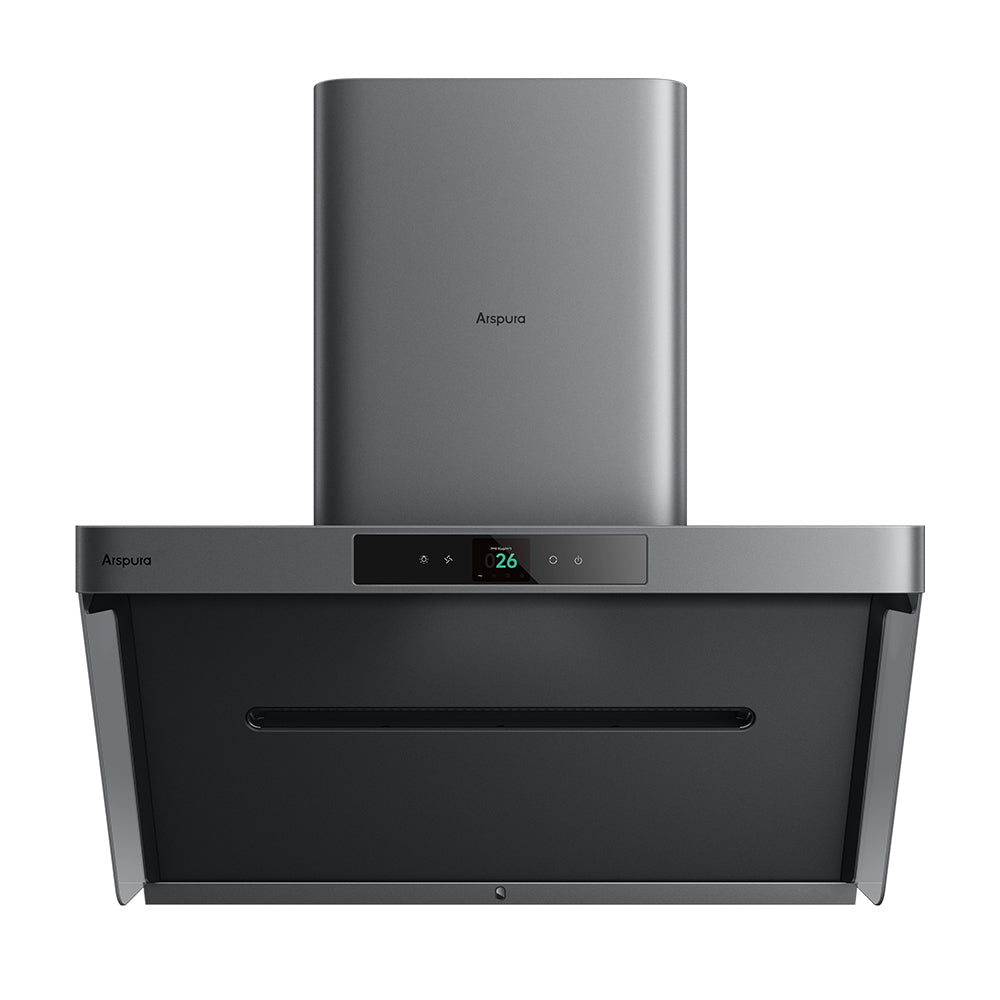
The Arspura 36" P1 IQV Range Hood lists at $1,099.99, reduced from $1,599.99, in Gray or Black. Its product description runs to fewer than three hundred characters and contains none of those three numbers. For an appliance in this price bracket, that is the review.

The range, as listed
| 36" P1 IQV™ | $1,099.99 (was $1,599.99) — Gray or Black |
|---|---|
| 36" P2 IQV™ | $1,799.99 |
| 30" F1 High-Velocity | $1,299.99 |
| Standard installation | +$199.00 |
| Advanced installation | +$399.00 |
| P1 duct cover extension | +$199.99 |
| Duct extension connector kit | +$49.99 |
| Stated claims | Continuous smoke removal, minimal noise, energy efficient |
| CFM · noise rating · duct size · filter type | None published |
Two things the price list tells you that the description does not
The 30-inch model costs $200 more than the 36-inch
This looks like a mistake until you read the model names. The 30" F1 is a "High-Velocity" hood at $1,299.99; the 36" P1 is an "IQV" hood at $1,099.99. They are different product lines, and the smaller, more expensive one is presumably the more powerful. But without CFM figures for either, there is no way to confirm that — you are choosing between two hoods on the basis of their marketing names.
The installed price is not $1,099.99
Arspura sells installation as a product: $199.00 standard, $399.00 advanced. A duct cover extension — needed on higher ceilings, which is most of the time on a chimney-style hood — is another $199.99, and a duct extension connector kit is $49.99.
A realistic figure for a 36" P1 with a duct cover and standard installation is therefore around $1,499, and closer to $1,700 if your kitchen needs the advanced install. That is not hidden — every item is priced openly, which I credit — but the headline number is the hood alone.
The specifications that should be there and are not
1. CFM
Cubic feet per minute is the fundamental capability of a range hood. Guidance for gas cooking commonly works out at roughly 100 CFM per 10,000 BTU of burner output, so a typical 40,000 BTU range wants somewhere around 400 CFM at the hood. Undersize it and grease and combustion byproducts stay in the room; oversize it in a tightly sealed house and you can create negative pressure that backdrafts other appliances. You cannot make either judgement without the number, and it is not given for any model in the range.
2. Noise, in sones or decibels
The description promises "super minimal noise levels" and "conversation comfort." Both are claims about noise, and neither is a measurement. Range hoods are conventionally rated in sones, and the difference between a hood at 2 sones and one at 7 is the difference between talking normally and shouting. On a product marketed specifically on quietness, publishing no figure is a conspicuous choice.
3. Duct diameter
Range hoods are typically 6 or 8 inches. If yours is 6 and the hood expects 8, you need a reducer — and a reducer costs you airflow and adds noise. Arspura sells a duct extension connector kit at $49.99 without saying what diameter anything is.
4. Filter type
Baffle filters are dishwasher-safe stainless steel that separate grease by forcing air to change direction; mesh filters are cheaper and clog faster. This determines your cleaning routine for the next decade and is not mentioned.
5. Ducted or ductless?
Given the duct accessories, this is clearly a ducted hood — but whether it can also run in recirculating mode with a charcoal filter is not stated, and that is the deciding question for anyone in an apartment who cannot vent outside.
6. What is "IQV"?
It is trademarked, it appears in two model names, and it is never explained anywhere on the listing. Likewise "Total Capture," which appears in the site heading. Both may describe genuine engineering; as presented they are names.
7. No dimensions, no weight, no warranty, no certification
No height range, no depth, no weight for a unit that hangs above a cooker, no warranty terms, and no reference to UL or ETL listing — which for a hard-wired kitchen appliance is what an electrician and an inspector will want to see.
What is genuinely promising
Offering installation at a fixed price
Range hood installation is the part most buyers dread — ducting, electrical connection, and cutting into a wall or ceiling. A manufacturer offering it at a stated $199 or $399, rather than leaving you to find a contractor, removes real friction, and pricing it openly is better than the common alternative of "contact us."
A coherent accessory ecosystem
Duct cover extensions matched to each hood model, plus a connector kit, means the parts you will need on a high ceiling are available from the same place rather than improvised from a hardware store.
Two finishes at the same price
Gray and Black both at $1,099.99, with no premium for the darker finish.
The $500 reduction, if real
$1,099.99 against $1,599.99 is a substantial gap. Whether $1,599.99 was ever the selling price is unknowable from here — treat $1,099.99 as the price.

Who should consider it
- Buyers who want installation handled. A fixed-price install offer has real value.
- Anyone renovating with a high ceiling. The duct cover extensions exist for exactly that.
- People who will ask for the spec sheet. The hood may be excellent — the page simply does not say.
Who should not
- Anyone matching a hood to a specific cooktop. No CFM figure means no way to size it.
- Open-plan kitchens where noise matters. The quietness claim has no number behind it.
- Replacing an existing hood. Duct diameter is unstated, and that decides whether it fits.
- Apartments without external venting. Recirculating capability is not addressed.
Verdict
I cannot tell you whether this is a good range hood, and that is precisely the problem. Arspura has produced a handsome-looking appliance, priced it competitively at $1,099.99 for 36 inches, offered fixed-price installation and built a sensible accessory range around it. Those are all good signs.
But a range hood listing without CFM, without a noise rating, without duct diameter and without filter type is missing every specification that determines whether the product will work in your kitchen. Before spending anything, ask Arspura for a full specification sheet covering those four points plus electrical requirements and UL or ETL listing. If the numbers are strong, the price and the installation offer make this genuinely interesting. If they will not provide them, buy a hood from a manufacturer that will.
All models and accessories are listed on the Arspura store, and our Arspura store page tracks their other live offers.
Disclosure: this article contains affiliate links. If you buy through them we may earn a commission at no additional cost to you. Prices were taken from the manufacturer listing at the time of writing and may change. Range hoods involve electrical and ducting work — installation should be carried out by a qualified professional in accordance with local building codes.