Horticultural lighting has one specification that matters above all others, and it is not watts. Watts measure electricity going in. What plants respond to is photosynthetic photon flux — PPF, measured in micromoles per second — which is the quantity of usable light coming out. The ratio between them, efficacy in µmol per joule, is how you compare two fixtures honestly.
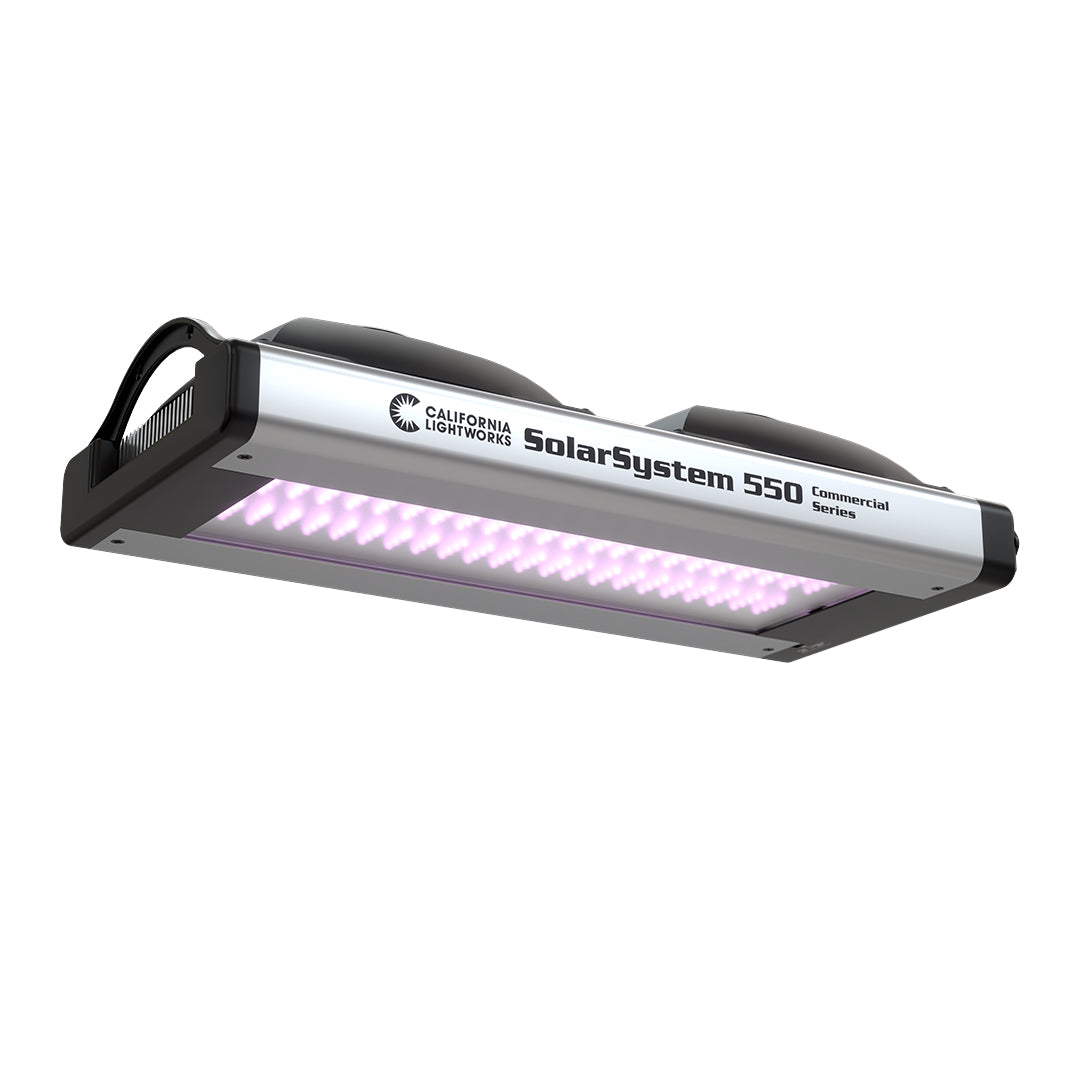
The industry largely made this shift a decade ago. So it is surprising to find the California LightWorks SolarSystem 550, at $639.00 down from $709.00, described entirely in watts and coverage area with no photon figures at all.

The specification, as listed
| Model | SolarSystem 550 |
|---|---|
| Price | $639.00 (was $709.00) — 120 V and 240 V both same price |
| Power draw | 0–400 W, dimmable |
| Current | 3.3 A at 120 V · 1.65 A at 240 V |
| Frequency | 50–60 Hz |
| Spectrum | Programmable across multiple wavelengths (requires SolarSystem Controller) |
| Bloom coverage | 4 × 4 ft |
| Vegetative coverage | 6 × 6 ft |
| Range | 275 $389 · 550 $639 · 550 UVB $839 · 1100 $1,274 · 1100 UVB $1,474 |
| PPF · efficacy · spectrum chart · DLC listing | Not published |
What California LightWorks does well
Publishing amperage at both voltages
This is genuinely useful and most fixtures omit it. Knowing the draw is 3.3 A at 120 V and 1.65 A at 240 V lets you calculate how many lights fit on a circuit before you call an electrician — on a 20 A circuit at 120 V, derated to 80% for continuous load, that is four fixtures. At 240 V you can run eight. For anyone scaling beyond a single light, this is the number that determines the electrical plan, and it is right there on the page.
Zero to 400 W dimming
Full-range dimming rather than fixed output is a real operational feature. Young plants need far less intensity than mature ones, and being able to dial a fixture down avoids light stress without moving the light or changing the fixture.
Programmable spectrum
Multi-channel spectrum control is the headline capability and it is uncommon at this price. Being able to shift the blue-to-red balance across a growth cycle, rather than buying separate veg and bloom fixtures, is genuinely valuable — and it is why the dedicated VEG model was discontinued.
Same price for 120 V and 240 V
No premium for the version that lets you build a more efficient installation.
Honest about the discontinued model
The old 550 VEG page states plainly that the product is discontinued and explains that the same veg spectrum is achievable on the standard 550 with a controller. Leaving a discontinued page up with a clear explanation is better practice than deleting it and leaving buyers with dead links.

The numbers that are missing
1. No PPF figure
This is the core issue. Without micromoles per second, "400 watts" tells you what the fixture costs to run and nothing about what it delivers. Two 400 W LED fixtures can differ by 40% or more in photon output depending on the diodes and drivers used. PPF is the number every serious horticultural lighting manufacturer publishes, and its absence here means you cannot compare this fixture to any competitor on the metric that matters.
2. No efficacy in µmol/J
The derived figure, and the one that determines running cost per unit of light. Current premium horticultural LEDs sit around 2.5 to 3.0 µmol/J and better; older generations are well below 2.0. Since electricity is the dominant lifetime cost of any grow light, efficacy is what decides whether a cheaper fixture is actually cheaper.
3. No PPFD map
Coverage is quoted as 4 × 4 ft for bloom and 6 × 6 ft for veg, with no mounting height and no intensity figures. Coverage area on its own is close to meaningless — every fixture "covers" a larger area if you hang it higher and accept less light. A PPFD map showing intensity at stated heights across the footprint is the standard way to present this, and it is not provided.
4. No DLC listing mentioned
The DesignLights Consortium horticultural qualified products list is what most utility rebate programmes require. On a $639 fixture, a rebate can be worth a meaningful fraction of the purchase price, and buyers scaling to several fixtures will care. No mention either way.
5. The controller is not included or priced here
Programmable spectrum — the main differentiator — requires a SolarSystem Controller. It is referenced on the discontinued VEG page and not offered, described or priced on this listing. If spectrum control is why you are buying, that is an unquantified additional cost. Ask before ordering.
6. No spectrum chart, no wavelength peaks
"Multiple wavelengths" without a spectral distribution graph. For a product sold on spectrum control, this is the illustration that should be first on the page.
7. No dimensions, weight, IP rating or warranty terms
A warranty tab exists on the page; no terms appear in the description. Physical dimensions and weight matter for rigging, and an ingress rating matters in a humid growing environment.
Who should buy it
- Growers who want one fixture across the whole cycle. Spectrum control is the reason, provided you budget for the controller.
- Anyone planning a multi-light electrical layout. The published amperage at both voltages is exactly what you need.
- Operations wanting dimming. 0 to 400 W is a wide, useful range.
- Buyers who prefer US-manufactured equipment. California LightWorks builds domestically.
Who should not
- Anyone comparing fixtures on specification. With no PPF or efficacy, comparison is impossible.
- Growers chasing utility rebates. Confirm DLC listing first.
- Buyers on a fixed budget. The controller cost is unstated.
- Anyone who needs a PPFD map to plan canopy height. Not provided.
Verdict
There is a capable fixture here. Full-range dimming, multi-channel programmable spectrum, US manufacture and — unusually — published electrical draw at both voltages point to a company that understands what a grower building a room actually needs to know.
Which makes the missing photon data harder to explain. Watts and coverage area were how grow lights were sold before the industry standardised on PPF and µmol/J, and a $639 fixture in a competitive market should publish both. Ask California LightWorks for the PPF, the efficacy, a PPFD map at a stated height, the DLC status and the controller price. Those five answers turn this from an unverifiable proposition into one you can properly evaluate — and given the rest of the specification, it may well hold up.
The full range is listed on the California LightWorks store, and our California LightWorks store page tracks their other live offers.
Disclosure: this article contains affiliate links. If you buy through them we may earn a commission at no additional cost to you. Specifications and prices were taken from the manufacturer listing at the time of writing and may change. High-output lighting draws significant current — electrical installation should be carried out by a qualified electrician, and appropriate eye protection should be used around horticultural LEDs.