Every hardware wallet claims to keep your private key offline. The interesting question is what "offline" means when the device still has to communicate with something. Most wallets bridge that gap with USB or Bluetooth — a data path that exists, however carefully it is guarded. Air-gapped wallets remove the path entirely and pass information as images on a screen.
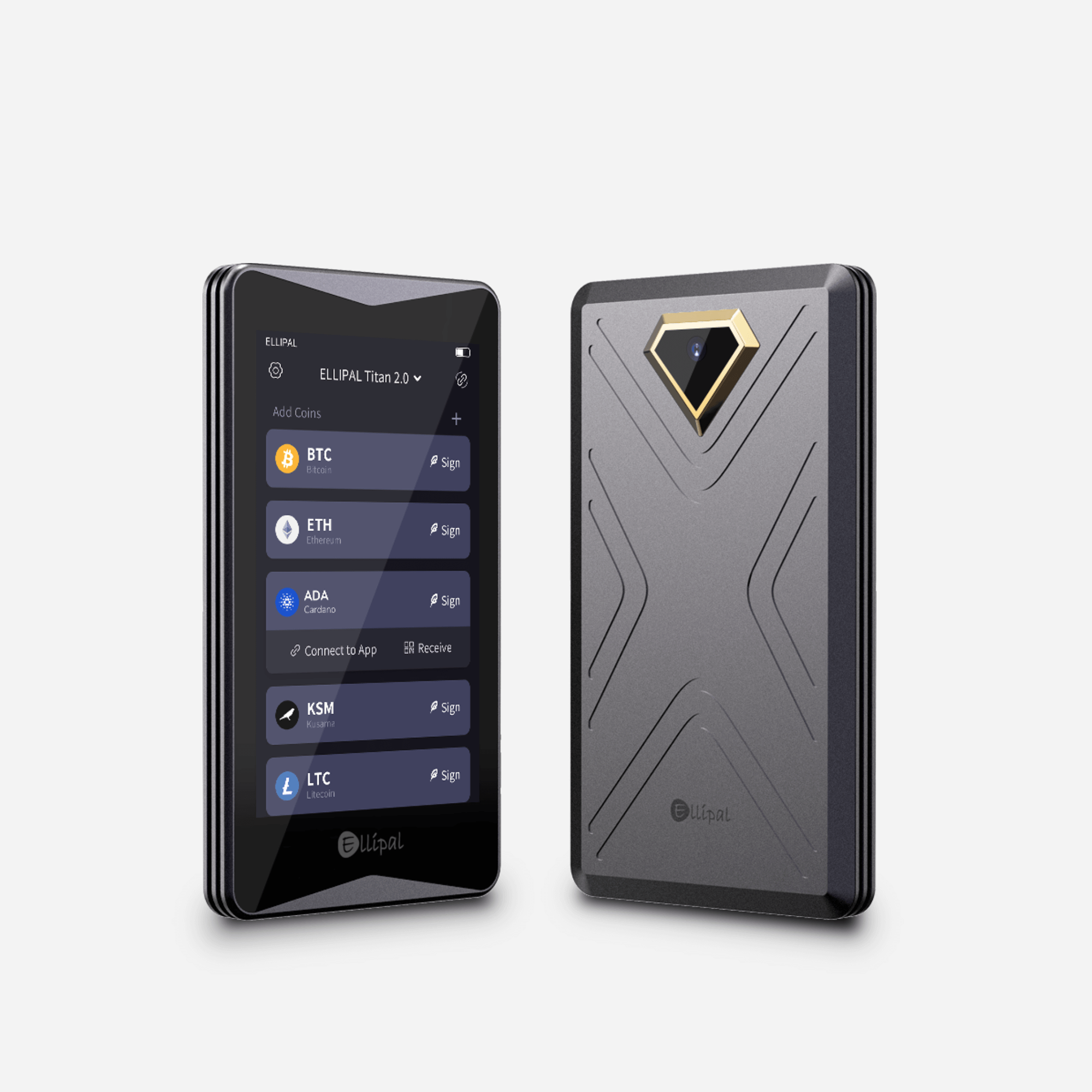
The ELLIPAL Titan 2.0 is built entirely around that decision. It costs $149.00, down from $169.00, in Grey or Golden, with a bundle including the X Card at $189.00. Below is what the architecture actually gives you, and the several things ELLIPAL does not put on the page.

The specification, as listed
| Product | ELLIPAL Titan 2.0 Cold Wallet |
|---|---|
| Price | $149.00 (was $169.00) · $189.00 with X Card |
| Colours | Grey, Golden |
| Screen | 4-inch touchscreen |
| Connectivity | None — no WiFi, Bluetooth, cellular or USB data path |
| Transaction method | QR code, scanned by the device camera and displayed on its screen |
| Secure element | CC EAL5+ certified chip |
| Body | Sealed metal, with self-destruct on physical tampering |
| Key standard | BIP39 seed phrase, self-custodial |
| Asset support | 10,000+ tokens across 45+ blockchains |
| Firmware updates | Applied without connecting to the internet |
What the design does well
The air gap is complete, not partial
This is the central claim and it is architecturally strong. No WiFi, no Bluetooth, no cellular, no USB data path — the only channel in or out is a camera reading a QR code and a screen displaying one. Optical transfer over a short distance cannot be exploited remotely in the way a wireless stack can, and it removes an entire class of attack surface that USB and Bluetooth wallets have to defend. Whether you need that depends on your threat model, but the engineering is coherent rather than cosmetic.
A 4-inch screen makes verification meaningful
Hardware wallets exist so you can verify a transaction on a device that malware on your computer cannot alter. That protection is only as good as your ability to actually read the details. Wallets with two-line monochrome displays force you to scroll through an address in fragments, and in practice most people stop checking. Four inches lets you see the whole transaction at once, which is the difference between real verification and theatre.
Standard BIP39, so you are not locked in
ELLIPAL states the device uses a standard BIP39 seed phrase recoverable on any BIP39-compatible wallet. This matters more than most buyers realise — it means your assets are not hostage to ELLIPAL continuing to exist or continuing to support your chains. Proprietary recovery schemes are a genuine risk in this category, and ELLIPAL avoiding one is the right call.
Tamper response on a sealed body
The private key sits in a CC EAL5+ chip inside a sealed metal shell, with a mechanism that wipes the device if the body is forced. Combined with PIN protection, that addresses the realistic physical scenario — a stolen device — rather than only the remote one.
Air-gapped firmware updates
Many "offline" wallets quietly require a cable for updates, which reopens the gap at exactly the moment you are installing new code. ELLIPAL states updates are applied without connecting the device to the internet, which keeps the security model consistent.

What is not on the page
1. CC EAL5+ certifies the chip, not ELLIPAL's firmware
This is the most important distinction in the whole listing and it is worth being precise about. Common Criteria EAL5+ is a certification applied to the secure element — the silicon. It says nothing about the code ELLIPAL wrote to run on it, the app, or the QR handling. A certified chip in a device with unaudited firmware is a partially certified product. ELLIPAL does not state whether its firmware is open-source or has undergone independent third-party audit, and in this category several competitors publish both. If you are protecting significant holdings, ask for that information directly.
2. No dimensions, weight or battery specification
Curiously, ELLIPAL publishes hardware specs for its $29.90 accessory adapter — size, weight, material — and none for the $149.00 wallet. There is no battery capacity, no stated runtime, and no charging time. A wallet with a battery can be flat when you need it, and battery life in a device that spends months in a drawer is a legitimate practical question.
3. QR signing is slower, and that is the trade
Every transaction involves showing a code to a camera, reviewing on the device, then showing a code back. It is not difficult, but it is several steps more than tapping a USB device. ELLIPAL effectively concedes this by positioning the Titan 2.0 as a home vault and selling the X Card for daily use. If you transact frequently, the air gap will feel like friction rather than protection.
4. Self-destruct is protection with a sharp edge
A mechanism that wipes on physical tampering is doing its job, but no guidance is given on what else might trigger it — drops, pressure, temperature, an attempted repair. If it fires, your seed phrase is the only route back. That is a strong argument for buying ELLIPAL's steel seed backup, or an equivalent, at the same time.
5. The app's buy, sell, swap and stake features involve third parties
These are convenience features routed through external service providers, and they carry their own fees and counterparty considerations that the listing does not detail. Using them is a different activity from cold storage, with a different risk profile. Check the fee structure before relying on them.
Who this suits
- Long-term holders storing at home. This is explicitly what ELLIPAL designed it for.
- Anyone who wants to actually read transactions before signing. The 4-inch screen is the reason.
- People uneasy about Bluetooth or USB wallets. The air gap removes that surface entirely.
- Multi-chain users. 45+ blockchains covers most portfolios.
Who should look elsewhere
- Frequent traders. QR signing every time will wear thin; ELLIPAL's own X Card exists for this reason.
- Anyone who requires open-source, independently audited firmware. Not stated here — verify before buying.
- Pocket carry. A 4-inch sealed metal device is a vault, not an everyday item; the Titan Mini at $79 targets that.
Verdict
As a piece of security hardware, the Titan 2.0 is well conceived. A genuine air gap, a screen large enough to make verification real, a certified secure element, tamper response, standard BIP39 recovery and offline firmware updates form a consistent design where each decision supports the others. At $149.00 it is competitively placed against other premium hardware wallets.
My reservations are about disclosure rather than design. The EAL5+ certification covers the chip and not ELLIPAL's own code, and nothing on the page addresses firmware auditing or open-sourcing — that is the question I would want answered before trusting any wallet with meaningful holdings. Basic hardware figures are also missing for the wallet while being published for a $29.90 accessory, which is an odd gap. Ask ELLIPAL directly, and store your seed phrase somewhere the device cannot take it with it.
Current pricing and both bundles are listed on the ELLIPAL store, and our ELLIPAL store page tracks their other live offers.
Disclosure: this article contains affiliate links. If you buy through them we may earn a commission at no additional cost to you. Specifications and prices were taken from the manufacturer listing at the time of writing and may change. This is a review of security hardware and is not financial or investment advice — we are not advising on whether to buy, hold or sell any digital asset. No hardware wallet eliminates risk; your seed phrase remains the ultimate point of failure.