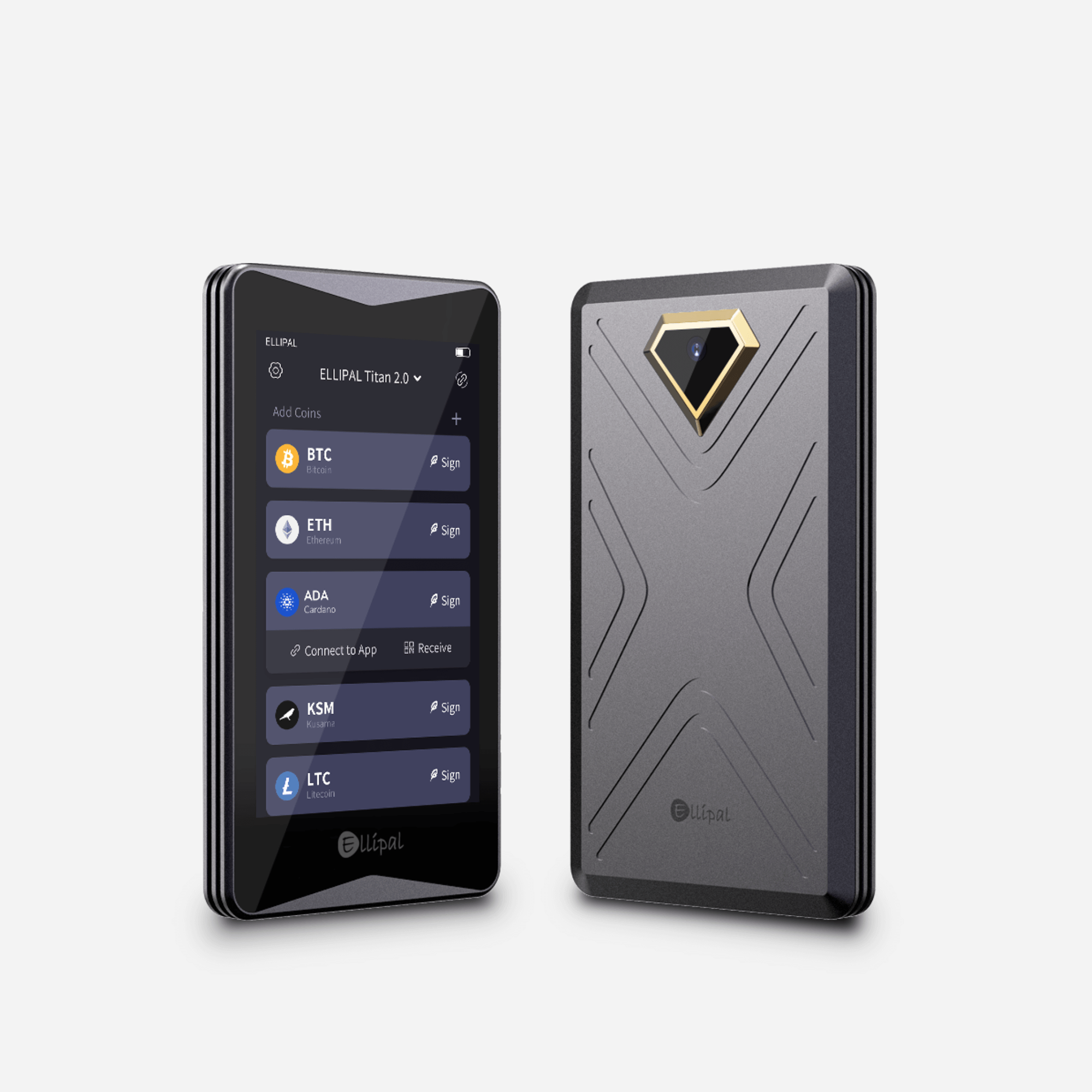
Most hardware wallets still plug into the machine you are trying to protect them from. The ELLIPAL Titan 2.0 takes the opposite position: no WiFi, no Bluetooth, no NFC, no USB data port, no SD card slot. Transactions move in and out as QR codes, scanned by the device camera. I have reviewed self-custody hardware for years, and this is one of the few designs where the threat model is legible from the spec sheet alone. Here is what it does, and what that architecture costs you day to day.

Specifications
| Wallet type | Self-custody, cold only |
|---|---|
| Connectivity | QR code signing (fully air-gapped) |
| Secure element | CC EAL5+ secure chip |
| Chassis | Full metal-sealed body |
| Tamper response | Self-destruct: auto-wipe on physical tampering or disassembly |
| Seed phrase | Creates 24-word; recovers 12/15/18/21/24-word |
| Passphrase | Supported |
| Firmware updates | Offline, via Security Adapter plus microSD |
| Mobile support | Android and iOS |
| dApps | WalletConnect; MetaMask connection supported |
| Assets | 10,000+ tokens across 45+ blockchains; NFTs on ETH and Polygon |
| Accounts | Up to 10 (5 seed-phrase, 5 private key / Keystore import) |
| Display | 4-inch IPS colour touchscreen |
| Dimensions | 118 x 66 x 9.7 mm |
| Weight | 140 g |
| Battery | 1400 mAh |
| Price | $149.00 (list $169.00) |
What air-gapped actually buys you
There is no data path to attack
The security argument here is structural rather than cryptographic. Remote attacks on hardware wallets overwhelmingly need a data channel: a malicious USB host, a compromised Bluetooth stack, a hostile firmware push. The Titan 2.0 removes all of them. Data enters and leaves through the camera and the screen, in QR form, at human speed. You cannot exploit a port that does not exist.
The tamper response is unusually aggressive
ELLIPAL specifies an all-metal sealed body with an auto-wipe triggered by physical tampering or disassembly. Combined with a CC EAL5+ certified secure chip, that covers the two ends of the threat spectrum most consumers actually face: remote compromise and a stolen device.
The 4-inch screen changes the verification habit
This is the underrated part. On a wallet with a tiny monochrome display, verifying a destination address is tedious enough that people skip it. A 4-inch colour touchscreen makes address and amount verification legible at a glance, and verification you actually perform is worth more than verification you theoretically could.

Three real drawbacks
1. Firmware updates need an accessory you have to buy separately
Offline firmware updates go through the ELLIPAL Security Adapter plus a microSD card. That accessory is listed on the ELLIPAL store at $29.90 and is not in the box with the wallet. It is a coherent design decision, but it means the true cost of keeping the device patched is closer to $179 than $149, and updating is a deliberate errand rather than a background task.
2. QR signing is slower than plugging in
Every transaction is a scan-show-scan cycle between phone and wallet. For a long-term store of value this is a non-issue. If you are an active DeFi user signing several transactions an hour, the friction is real and you will feel it. Buy this for a vault, not for a trading desk.
3. 140 g and 118 mm is a device, not a key
At 118 x 66 x 9.7 mm and 140 g, the Titan 2.0 is roughly phone-sized. It is not something you carry on a keyring, and it has a 1400 mAh battery that needs occasional charging. Anyone who wants pocketable cold storage should look at the smaller ELLIPAL models instead. There is also a hard ceiling of 10 accounts, which power users managing many wallets will hit.
Who should buy it
- Long-term holders who want a genuine vault and are happy to trade convenience for isolation.
- Anyone who does not trust their own computer, which after a decade of supply-chain incidents is a reasonable position.
- Multi-chain holders: 45+ blockchains and 10,000+ tokens covers most realistic portfolios.
- People who will actually verify addresses if the screen makes it easy.
Who should skip it
- High-frequency DeFi users who sign constantly.
- Anyone wanting a keyring-sized device.
- Users managing more than 10 accounts on one device.
- Buyers who will resent paying extra for the Security Adapter to update firmware.
Verdict
At $149 the Titan 2.0 is priced against mainstream USB wallets while offering a materially different security architecture. The trade is explicit and honest: you give up speed and pocketability, and you get a device with no data path for a remote attacker to use. For cold storage that is the correct trade. Just budget for the Security Adapter and go in understanding that this is a vault, not a daily driver.
Nothing here is financial advice; self-custody carries its own risks, and a wallet only protects the seed phrase you store safely.
See the current Titan 2.0 price at the official ELLIPAL store. Current promotions and the wider product line are collected on our ELLIPAL store page, and you can view the full ELLIPAL wallet range here.
Disclosure: this article contains affiliate links. If you buy through them we may earn a commission at no extra cost to you. Specifications and prices come from the manufacturer listing at the time of writing and may change.