Here is something the matcha industry would rather you did not dwell on: "ceremonial grade" is not a regulated term. No Japanese authority defines it, no certification body audits it, and there is no minimum standard a powder must meet to carry the label. Any seller can print it on any tin.
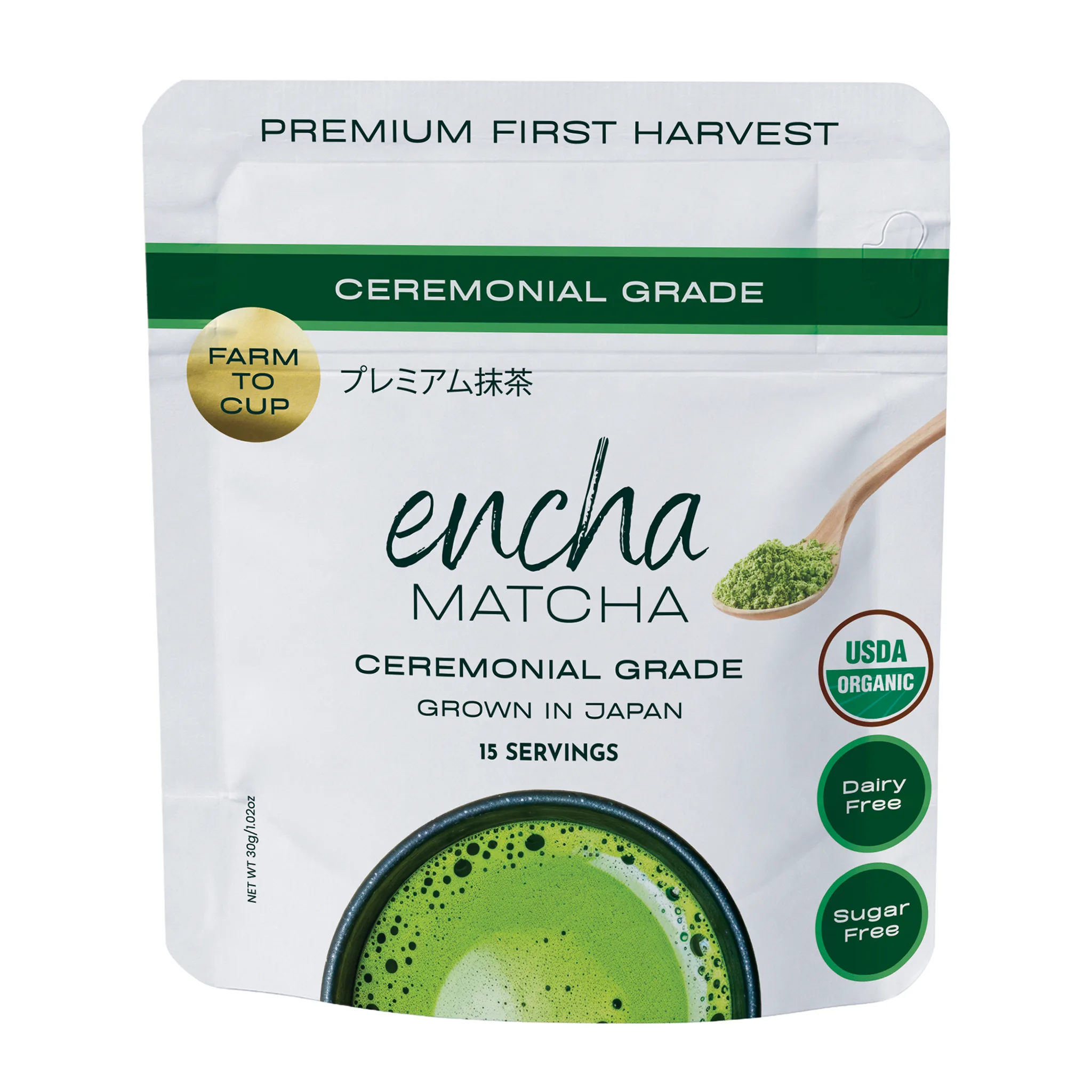
That does not make it meaningless — it signals an intention to sell drinking-quality matcha rather than culinary powder — but it means the label alone tells you nothing. What tells you something is everything around it. The Encha Ceremonial Grade Matcha Powder starts at $19.99 for 30 g, and the surrounding detail is unusually specific.

The range, as listed
| 30 g (1.06 oz), 15 cups | $19.99 — $0.67 per gram, $1.33 per cup |
|---|---|
| 60 g (2.12 oz), 30 cups | $34.99 — $0.58 per gram, $1.17 per cup |
| 500 g (1.1 lb), 250 cups | $189.99 — $0.38 per gram, $0.76 per cup |
| Single-serve sticks, 30 pack | $39.99 — $1.33 per serving |
| Leaf | Spring's youngest leaves, shade-grown, hand-picked |
| Processing | Picked within 24 hours of harvest, stone-ground on Japanese millstones |
| Blend | Six cultivars from Kagoshima, Miyazaki, Shizuoka and Uji |
| Sourcing | Direct farm partnerships over twelve years |
| Certification | USDA Certified Organic, third-party tested for purity |
| Single-cultivar reserves | Saemidori and Okumidori, $39.99 each |
Work out which size you actually want
The price per gram varies more than most people notice. The 500 g tin works out at $0.38 per gram — 43% cheaper than the 30 g tin at $0.67. On paper the large tin is obviously the buy.
In practice it usually is not, and this is the most useful thing I can tell you about buying matcha. Matcha is a fine powder with an enormous surface area, and it oxidises quickly once exposed to air, losing both its bright green colour and its sweetness within weeks of opening. Five hundred grams is 250 cups. Unless you are drinking matcha every single day — or running a café — that tin will be past its best long before you reach the bottom, and stale matcha at $0.38 a gram is worse value than fresh matcha at $0.67.
The 60 g tin at $0.58 per gram is the sensible middle for a regular drinker: a month of daily cups, at a 13% saving over the small tin. Buy the 30 g first to find out whether you like it.
What Encha does well
Naming regions and cultivars
Six cultivars from four named growing regions — Kagoshima, Miyazaki, Shizuoka and Uji — is far more transparency than the category norm, where "product of Japan" is often the extent of it. It also explains the blend's purpose: multiple cultivars from multiple regions is how you produce a consistent flavour year after year, insulated from any single farm's bad season.
Picked within 24 hours, stone-ground
Both matter. Tea leaves begin degrading immediately after picking, so the interval between harvest and processing is a genuine quality variable. Stone grinding is slow — a traditional granite mill produces roughly 30 to 40 grams an hour — but it does not heat the leaf. Industrial grinding is faster and generates heat that damages the delicate compounds you are paying for. Naming the method is meaningful.
Shade-grown, first spring leaves
Shading the plants before harvest increases chlorophyll and L-theanine while reducing catechins, which is precisely what produces the sweet, umami-rich, non-bitter cup that separates good matcha from grassy, astringent matcha. This is the actual mechanism behind the flavour claims.
Single-cultivar reserves alongside the blend
Offering Saemidori and Okumidori as unblended single-harvest lots at $39.99 shows the brand understands its own product. Blends are for consistency; single cultivars are for people who want to taste the difference between one and another.
USDA Organic and third-party testing
Organic certification on matcha matters more than on most foods, because you consume the entire leaf rather than an infusion. Anything on or in that leaf goes into your cup.

What I would want added
1. "Third-party tested for purity" needs specifics
Tested for what, by whom, and with what results? The reason this matters for matcha specifically: because you drink the whole ground leaf, matcha carries higher exposure to anything the plant absorbed — heavy metals such as lead being the well-documented concern in tea generally. A brand that tests should publish what it tests for and, ideally, the certificate of analysis. Saying "tested for purity" without naming the analytes is a claim you cannot evaluate.
2. No harvest date and no best-before
For a product whose entire quality proposition rests on freshness, and where the listing itself emphasises first-harvest spring leaves, the absence of a harvest year on the page is a real gap. Good matcha sellers date their tins. This is also the information you need to decide whether the 500 g tin makes sense for you.
3. No caffeine content
Matcha is meaningfully caffeinated — you are consuming the leaf, not an infusion of it — and typically delivers more caffeine per cup than steeped green tea. Anyone managing their intake, pregnant, or sensitive to caffeine needs that number, and it is not given.
4. The single-serve sticks are not a saving
At $39.99 for 30 sticks, they cost $1.33 per serving — identical to the 30 g tin, and 14% more than the 60 g. You are paying the same for convenience, which is fair, but do not mistake them for a bulk option.
5. A small tension in the brand story
The site positions itself around Uji, while this particular product is a blend across four regions of which Uji is one. Neither fact is hidden; they simply sit slightly at odds, and a reader skimming might assume the blend is entirely Uji matcha.
Who should buy it
- Anyone moving up from supermarket matcha. Shade-grown, stone-ground, first-harvest is a different drink entirely.
- Daily drinkers. The 60 g tin at $1.17 a cup is well priced for what it is.
- People who care about sourcing. Named cultivars, named regions, organic certification.
- Anyone curious about cultivars. The single-origin reserves make that comparison possible.
Who should not
- Occasional drinkers eyeing the 500 g tin. It will oxidise before you finish it.
- Baking and smoothies. Culinary grade costs a fraction and the subtlety is lost anyway.
- Anyone managing caffeine intake. Ask for the figure first.
- Buyers who want to see test results. The testing is claimed but not documented.
Verdict
Encha describes its matcha the way someone who understands matcha would: named cultivars, named regions, time from harvest to processing, grinding method, and the shading that actually creates the flavour. That is a considerably higher standard of disclosure than most of this category manages, and at $19.99 for 30 g the entry price is reasonable for genuine drinking-grade powder.
Ask for the harvest year and the specifics behind "third-party tested" before ordering, because those are the two claims that need substantiating rather than repeating. And buy the 60 g rather than the 500 g unless matcha is genuinely a daily habit — freshness is worth more than the 43% per-gram saving on a tin you will not finish.
All sizes and the reserve cultivars are listed on the Encha store, and our Encha store page tracks their other live offers.
Disclosure: this article contains affiliate links. If you buy through them we may earn a commission at no additional cost to you. Prices and specifications were taken from the retailer listing at the time of writing and may change. This article is not nutritional or medical advice — if you are pregnant, breastfeeding or managing caffeine intake, speak to a healthcare professional.