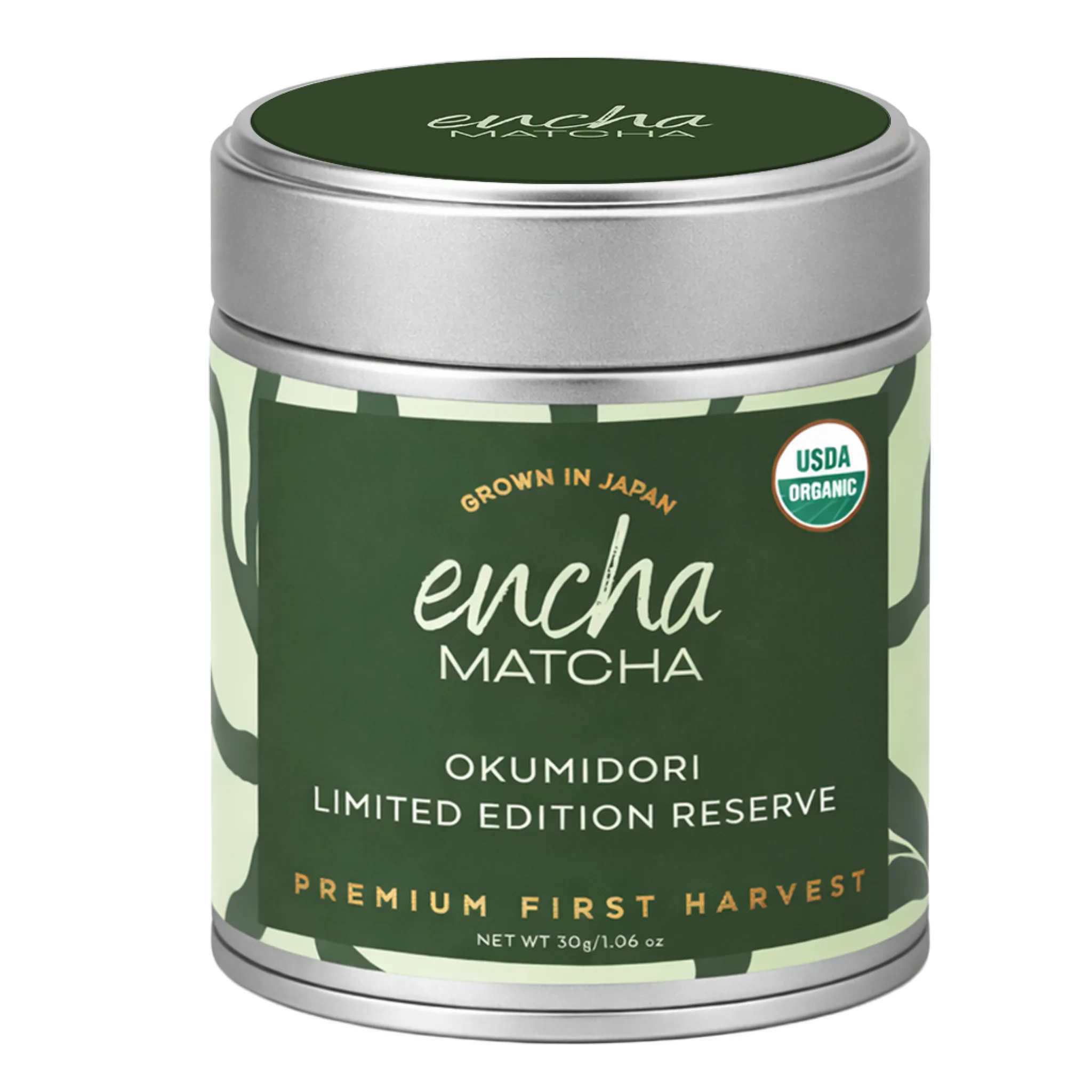
I have spent years working with Japanese green tea, and the single most useful thing I can tell a matcha buyer is this: cultivar and origin tell you far more than the words on the front of the tin. "Ceremonial grade" is not a regulated term. "Single cultivar, single region, single harvest, never blended" is a set of claims that can actually be checked. Encha's Okumidori Limited Edition Reserve makes the second kind of claim, which is why it is worth taking seriously.

Product Details
| Product | Encha Matcha Tea Okumidori Limited Edition Reserve — Ceremonial Grade Matcha Powder |
|---|---|
| Cultivar | Okumidori (おくみどり), single cultivar, never blended |
| Origin | Volcanic soil of Kagoshima, Japan |
| Cultivation | Shade-grown using traditional honzu methods |
| Processing | Hand-picked, stone-ground |
| Harvest | First harvest, once per year, limited quantities |
| Certification | USDA Certified Organic; non-GMO; dairy-free; zero sugar |
| Ingredients | Organic matcha green tea powder (single ingredient) |
| Stated tasting notes | Dark chocolate richness, walnut creaminess, lingering buttery umami |
| Ceremonial flavour profile (Encha's own scale) | Umami 90, Sweetness 70, Body 55, Grassiness 45, Bitterness 5 |
| Serving guidance | 1 tsp, approximately 2 g per serving |
| Price | $39.99, free shipping |
What Makes This Tin Different
Okumidori is a cultivar chosen for depth, not brightness
Okumidori translates as "deep green", and the name is descriptive rather than poetic. It is a late-harvesting cultivar prized for producing a heavier, rounder cup than the more famous Yabukita, and Encha's own tasting notes — dark chocolate richness, walnut creaminess, a lingering buttery umami — line up with what the cultivar is known for. If you have found lighter matcha thin or overly vegetal, this is the flavour direction that tends to convert people.
Honzu shade-growing is the expensive way to do it
Shading the plants before harvest raises the amino acid content, especially L-theanine, which is what produces umami and suppresses bitterness. Honzu is the traditional method — layered natural materials rather than modern synthetic cloth — and it is significantly more labour-intensive. That is a real cost input, and it shows up in the listed bitterness score of 5 out of 100 on Encha's own scale against an umami score of 90.

Single origin, single harvest, never blended
Most matcha on the market is blended across farms and harvests to hit a consistent flavour target at a consistent cost. Blending is not a flaw — it is what makes a reliable everyday tin possible — but it does mean you are drinking an average. Encha states this is grown exclusively in Kagoshima, harvested once per year in limited quantities, and never blended. That is a fundamentally different product proposition, and the "limited edition" framing is a consequence of it rather than a marketing invention.
Stone-ground and hand-picked
Stone grinding is slow — traditional granite mills produce on the order of tens of grams per hour — and it keeps the powder cool, which protects the volatile compounds that carry aroma. Combined with hand-picking, these are the two process steps that separate ceremonial-grade tea from culinary powder, and Encha specifies both.
Four Honest Criticisms
1. The listing does not publish the tin size
This is my biggest complaint, and it is a straightforward one. Encha's standard ceremonial grade is sold in a clearly labelled 30 g (1.06 oz) tin making 15 cups at $19.99, and the barista grade latte powder is $11.99. The Okumidori Reserve listing shows a single default option at $39.99 with no weight stated. Encha's own serving guidance is 1 tsp or roughly 2 g, so cost per cup is entirely dependent on a number the product page does not give you. Ask before ordering.
2. $39.99 is a substantial premium over the house ceremonial grade
Against $19.99 for the standard 30 g ceremonial tin, the Reserve is double the price. Single-cultivar limited harvests genuinely cost more to produce, and that premium is defensible — but it is a premium you should be buying deliberately, for the cultivar character, not by default.
3. Limited annual harvest means you cannot rely on it
"Harvested once per year in limited quantities" is the honest downside of the honest upside. If this becomes your daily tea, there will be a point in the year when it is unavailable, and next year's harvest will not taste identical. Single-origin agricultural products vary by season. That is the deal.
4. Ceremonial grade is for water, not for lattes
Encha is clear that its ceremonial grade is best enjoyed straight with water only, and that a separate latte grade exists for milk. Using a $39.99 single-cultivar reserve in a milk drink buries most of what you paid for. If lattes are your habit, the barista grade at $11.99 is the product that actually suits you — and that is Encha telling you so, not me.
Who Should Buy It
- Drinkers who take matcha with water and will actually taste the cultivar character.
- Anyone who has found standard matcha too grassy or too thin — Okumidori's heavier profile is the usual fix.
- People who care about provenance and want single-region, single-harvest traceability.
- Gift buyers looking for something with a genuine story behind it rather than packaging.
Who Should Not
- Latte drinkers. Buy the barista or latte grade and spend the difference on better milk.
- Cooking and baking users — culinary powder exists precisely so you do not do this.
- Anyone who needs cost-per-serving clarity before buying, given the unpublished tin size.
- Daily drinkers on a budget — the $19.99 standard ceremonial tin is the sensible everyday choice.
Verdict
The Okumidori Limited Edition Reserve is the kind of product I want more brands to make: a specific cultivar from a specific region, processed traditionally, with the claims stated plainly enough to be checked. The flavour direction — deep, creamy, chocolate-and-walnut rather than bright and grassy — is a genuine point of difference, and honzu shade-growing with stone grinding is the expensive way to get there. The one thing standing between this and an unreserved recommendation is the missing weight on the product page. At $39.99 with no stated tin size, you cannot calculate what a cup costs, and for a tea sold on transparency that omission stands out. Confirm the size with Encha, and if the answer works for you, this is a serious matcha.
Check current Encha Okumidori Reserve pricing and availability here.
All live offers are listed on the Encha store page, or visit the official Encha store.
Disclosure: this article contains affiliate links. If you buy through them we may earn a commission at no additional cost to you. Specifications and prices come from the official product listing at the time of writing and may change.