Almost all matcha sold in the West is blended. Producers combine leaf from several cultivars and often several regions to hit a consistent house flavour year after year - which is a perfectly respectable thing to do, and it is why most matcha tastes broadly similar. Single-cultivar matcha is the opposite proposition: one variety, one place, one harvest, and whatever character that combination produced this year.
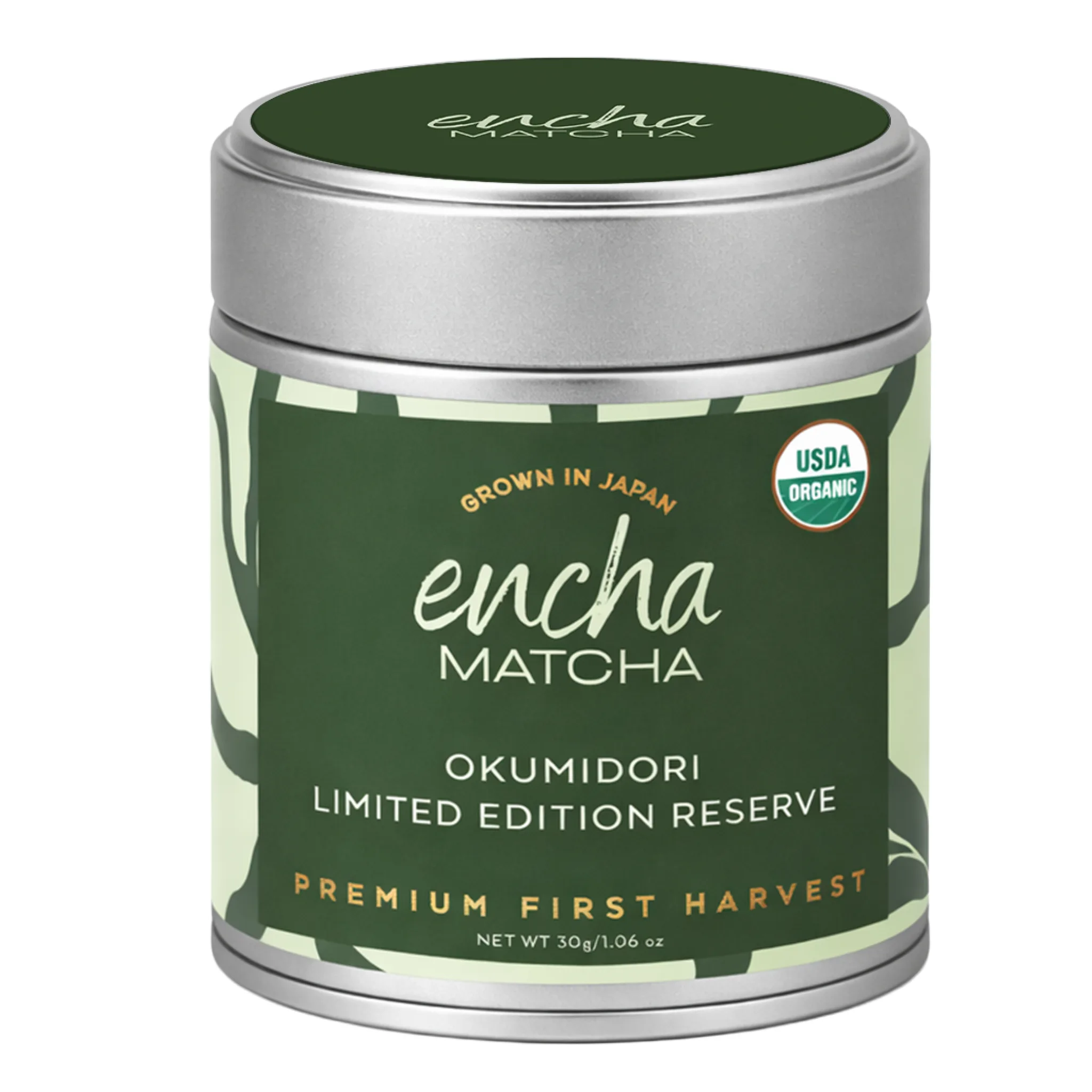
Encha's Okumidori Limited Edition Reserve at $39.99 is that second kind, and the production details behind it are genuinely serious. Two pieces of information are missing, and for matcha specifically they are the two that matter most.

Published specification
| Specification | Value |
|---|---|
| Cultivar | Okumidori, single cultivar, never blended |
| Origin | Kagoshima, Japan - volcanic soil |
| Shading method | Traditional honzu |
| Picking | Hand-picked |
| Milling | Stone-ground |
| Harvest | First harvest, once per year, limited quantity |
| Certification | USDA Certified Organic |
| Stated profile | Dark chocolate richness, walnut creaminess, buttery umami |
| Preparation | 1 tsp into 5 oz water at 160°F |
| Price | $39.99 |
Honzu shading and first harvest are the two claims that carry weight
Let me explain why these are not decorative.
Shading is what makes matcha matcha. Covering the plants for several weeks before harvest starves them of light, which causes the leaf to produce more chlorophyll and, critically, to retain more L-theanine rather than converting it to catechins. L-theanine is the amino acid responsible for umami and sweetness; catechins are responsible for bitterness and astringency. More shade means sweeter, rounder, less bitter tea - and a deeper green colour.
Honzu (本簀) is the traditional method: a structure of reed screens and rice straw built over the field, layered progressively. It diffuses light rather than simply blocking it, and it moderates temperature and humidity around the leaf. It is labour-intensive and increasingly rare - most modern production uses black synthetic mesh, which is cheaper and works, but not identically. Claiming honzu specifically is a meaningful production claim.
First harvest (ichibancha) is the spring flush, and it is the best leaf of the year - youngest, highest in amino acids, lowest in the bitter compounds that build through summer. Encha's own catalogue makes the distinction explicitly, describing their everyday latte-grade product as second harvest. Being told which flush you are buying is unusually transparent.
Okumidori is a real, named cultivar known for deep colour and a mellow, rich profile - so the stated tasting notes of chocolate, walnut and buttery umami are plausible rather than generic. Stone-grinding matters too: granite mills turn slowly enough to avoid heating the leaf, and heat destroys aroma compounds. And Kagoshima's volcanic soil is a legitimate terroir claim - it is Japan's second-largest tea region and its southern climate produces an earlier, distinctly rich style.
Three honest drawbacks
1. The net weight is not published. This is the most basic omission possible for a food product, and it makes the price impossible to evaluate. Ceremonial matcha typically ships in 20 g, 30 g or 40 g tins, and $39.99 is either good value or poor value depending entirely on which. At the stated serving of one teaspoon (roughly 2 g), a 30 g tin is about fifteen bowls - just over $2.60 each. A 20 g tin would be ten bowls at $4 each. You cannot make that calculation from the page. Ask before ordering.
2. No harvest date or best-before date is given. For matcha this is arguably more important than for any other tea. Once leaf is stone-ground, the enormous surface area oxidises quickly - matcha loses colour, aroma and sweetness over months, not years, even sealed. Serious vendors publish the harvest year and often the milling date. A product sold on the strength of being a limited single-harvest reserve should certainly say which harvest. Ask for the date and buy the freshest available; and once opened, keep it sealed, cold and away from light.
3. "Ceremonial grade" is not a regulated term. There is no certifying body and no legal definition - any seller may use it. That is not a criticism of Encha specifically, whose supporting details are far more substantive than most, but it is a reason to buy on the verifiable claims (cultivar, region, harvest, shading method, organic certification) rather than on the grade label. Note too that USDA Organic covers pesticide and farming practice, not flavour or quality - and it does not involve heavy metal or contaminant testing, which some matcha buyers care about and which is not mentioned here.
Who should buy it - and who should not
Buy it if you drink matcha straight - whisked with water, usucha style - and you are interested in tasting one cultivar from one place rather than a consistent house blend. That is the only context in which paying for single-origin first-harvest leaf makes sense, and Encha has been unusually forthcoming about the production. Follow their preparation guidance closely; 160°F is deliberately below boiling because hotter water extracts bitterness and destroys the character you paid for.
Skip it if you drink matcha lattes - milk and sweetener will obliterate the distinctions you are paying a premium for, and Encha's own barista-grade product at $11.99 is designed for exactly that job. Skip it if you cannot get the net weight, or if you are new to matcha entirely; start with something cheaper, learn what you like, then come back to single cultivars.
Verdict
On production credentials this is a serious product. Single cultivar, named region, traditional honzu shading, hand-picked, stone-ground, first harvest, organic - that is a coherent set of claims that all point the same direction, and it is far more information than most matcha sellers offer. The frustration is that the two most practical facts, how much you get and how fresh it is, are the ones left out. Ask both questions, and if the answers are good, this is a properly interesting cup.
Current pricing and the wider range are on the official Encha store, and our brand overview is on the Encha store page.
Disclosure: this article contains affiliate links. If you buy through them we may earn a commission at no extra cost to you. All product details and prices were taken from the seller's official product page and are subject to change.