The difference between a cool box and a compressor fridge is the difference between delaying spoilage and preventing it. Thermoelectric coolers — the ones that plug into a cigarette lighter and cost fifty dollars — can only pull the temperature a fixed number of degrees below ambient. Park in the sun at 35°C and your "fridge" is holding food at 15°C, which is not refrigeration in any meaningful sense.
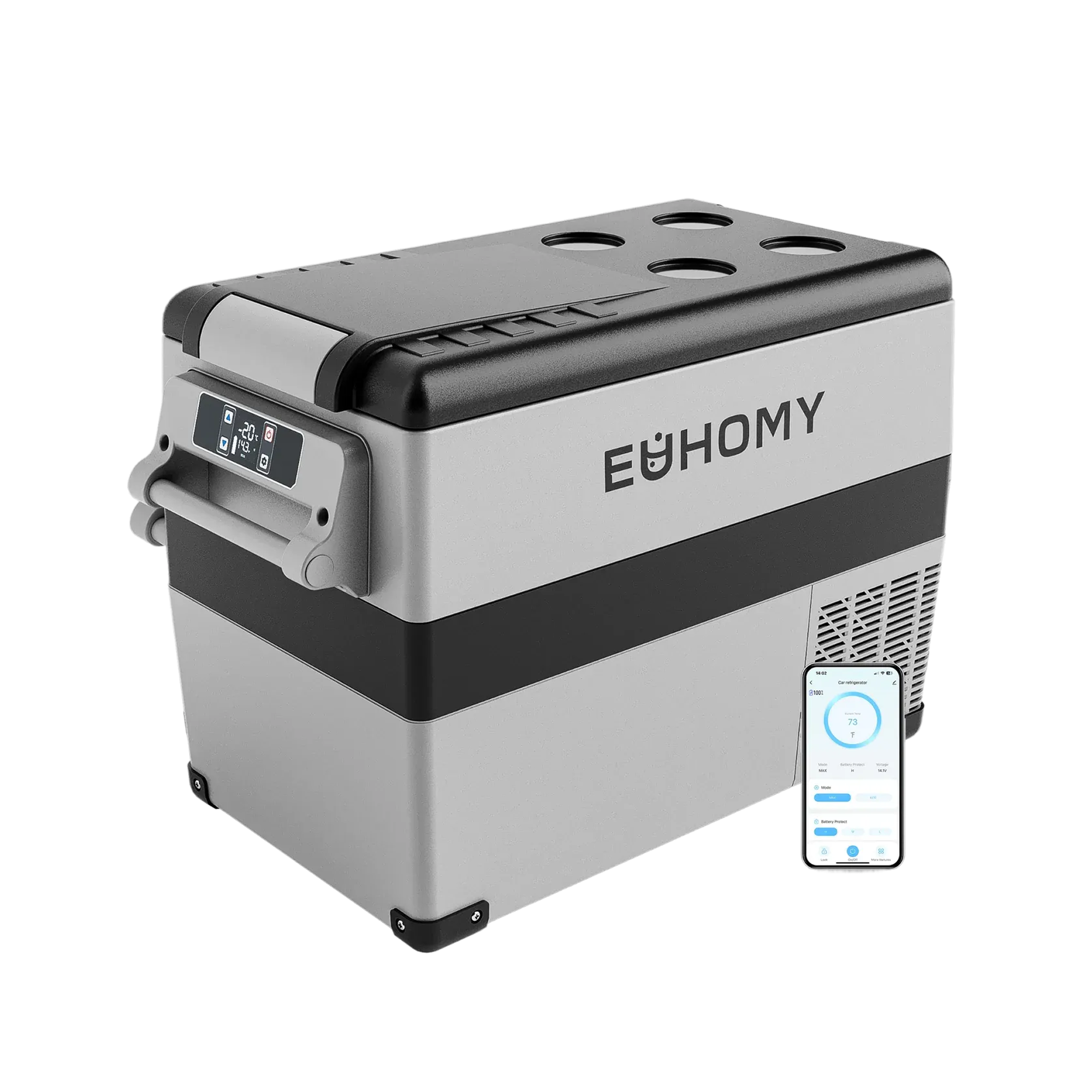
A compressor unit sets an actual temperature and holds it. The Euhomy Rover H1 is one, starting at $199.99 for the 37-quart model, and it publishes a specification sheet detailed enough to actually evaluate — which is rarer in this category than it should be.

The specification, as listed
| Model | Euhomy Rover H1 Car Refrigerator |
|---|---|
| Prices | $199.99 (35 L / 37 qt) · $229.99 (45 L / 48 qt) · $259.99 (55 L / 59 qt) |
| Temperature range | -20°C to 20°C (-4°F to 68°F) |
| Refrigerant | R600A, 20 g / 0.71 oz |
| Weight (37 qt) | 12.8 kg / 28.2 lbs |
| Dimensions (37 qt) | 27.2" × 13.8" × 15.1" |
| Dimensions (48 qt) | 27.2"D × 13.6"W × 17.7"H |
| Dimensions (59 qt) | 27.44"D × 13.78"W × 21.06"H |
| Power input | 12/24 V DC and 120/240 V AC adapters included |
| Defrost | Frost free |
| Control | LCD touch panel plus Bluetooth app |
| Layout | Dual storage area, single door |
What the Rover H1 gets right
-20°C is a real freezer, not a cold box
This is the specification that justifies the price. Reaching -20°C means the Rover H1 can hold frozen food frozen — ice cream, meat, frozen meals — indefinitely, regardless of how hot it is outside the vehicle. Being able to set anywhere from -4°F to 68°F also means it works as a fridge, a freezer, or a wine-temperature cabinet depending on the trip. A thermoelectric cooler cannot do any of that.
R600A is the right refrigerant choice
R600A is isobutane, with a global warming potential in the single digits compared to several hundred or more for older HFC refrigerants. It is also efficient in small systems, which is why premium domestic fridges use it. Twenty grams is a small charge, and specifying both the refrigerant type and quantity is the kind of detail that suggests a manufacturer taking the engineering seriously.
Both AC and DC adapters in the box
Included 12/24 V DC and 120/240 V AC adapters mean the fridge works in a car, in a truck with a 24 V system, and in a house or hotel room — without buying anything extra. Plenty of competitors sell the AC adapter separately, which quietly adds thirty dollars and an ordering delay.
Full dimensions for all three sizes
Euhomy publishes exterior dimensions for every capacity, which is precisely what you need when the question is "will this fit in my boot alongside everything else." Notice the depth barely changes between 37 and 59 quarts — 27.2 to 27.44 inches — while the height goes from 15.1 to 21.06 inches. The larger models grow upward, not outward, which is useful to know if you are packing under a parcel shelf or a canopy.
Frost free on a portable unit
Manual defrosting a car fridge means emptying it and dealing with meltwater in a vehicle. A frost-free system avoids that entirely, and it is not standard at this price.

What is missing, and it matters
1. No battery protection detail
This is the most consequential omission for anyone running the fridge from a vehicle. A compressor fridge left running with the engine off will flatten a car battery. Good units offer selectable low-voltage cutoff levels — typically low, medium and high — that shut the compressor down before the battery drops too far to start the engine. Nothing in the listing states whether the Rover H1 has this, or at what voltage it intervenes. If you plan to leave it running overnight while camping, get this confirmed before you buy. It is the difference between a good morning and a jump start.
2. No power consumption figure
No wattage, no current draw, no duty cycle percentage. Without those you cannot calculate how long the fridge will run from a leisure battery or a portable power station, which is the single most common question owners have. A rough figure would be enough; none is given.
3. "Low noise" with no decibel rating
Compressors cycle, and in a quiet campsite or a car you are sleeping in, that cycling is audible. Euhomy claims high efficiency and low noise but publishes no dB figure to support it.
4. "Dual storage area" is not dual zone
Read this carefully. The listing describes a dual storage area and a single door, and nowhere claims independent temperature control for each compartment. That means one cooling zone with a divider — useful for organisation, but you cannot run one side as a freezer and the other as a fridge the way a true dual-zone unit allows. If you need both simultaneously, verify this before ordering.
5. Bluetooth, not WiFi
App control over Bluetooth works when you are next to the fridge. It will not let you check the temperature from a restaurant while your food sits in the car — which is the scenario where remote monitoring would actually be useful.
6. Weight given for one size only
The 37-quart model is 28.2 lbs empty. No figures for the 48 or 59-quart versions, both of which will be heavier — and a loaded 59-quart fridge is a genuinely awkward two-person lift into a vehicle.
Who should buy it
- Campers and overlanders. True freezing capability changes what food you can carry.
- Long-distance drivers and truckers. The 24 V DC option is specifically for you.
- Anyone transporting temperature-sensitive goods. Set-and-hold beats ice every time.
- Van and RV users. Frost free and AC/DC flexibility suit semi-permanent installation.
Who should not
- Anyone needing simultaneous fridge and freezer. Dual storage is not dual zone — confirm first.
- Off-grid users with tight power budgets. No consumption figures published, so you cannot plan.
- Occasional picnic use. A cool box and ice costs a fraction of this.
- Anyone leaving it running on a starter battery. Not until battery protection is confirmed.
Verdict
The Rover H1 is a properly specified compressor fridge at a price that makes the category accessible. A -20°C to 20°C range, R600A refrigerant, frost-free operation, both power adapters included and full dimensions for all three sizes is a genuinely strong sheet, and $199.99 for a real 37-quart compressor unit is competitive.
The gaps are all in the same place: power. No consumption figure, no battery protection specification, no noise rating. For a device whose entire purpose is running off a vehicle's electrical system, those are the numbers that determine whether it works for your use case, and they are the ones Euhomy declines to print. Ask before ordering — particularly about low-voltage cutoff — and be clear that dual storage does not mean dual zone.
All three capacities and current pricing are listed on the Euhomy store, and our Euhomy store page tracks their other live offers.
Disclosure: this article contains affiliate links. If you buy through them we may earn a commission at no additional cost to you. Specifications and prices were taken from the manufacturer listing at the time of writing and may change.