Range claims are the most misleading number in the e-bike industry, and the reason is simple physics that any buyer can check for themselves. Once you know how, you will never read a range figure the same way again - and the Kingbull Hunter 2.0 is a good worked example, because Kingbull is at least honest enough to attach a qualifier to theirs.
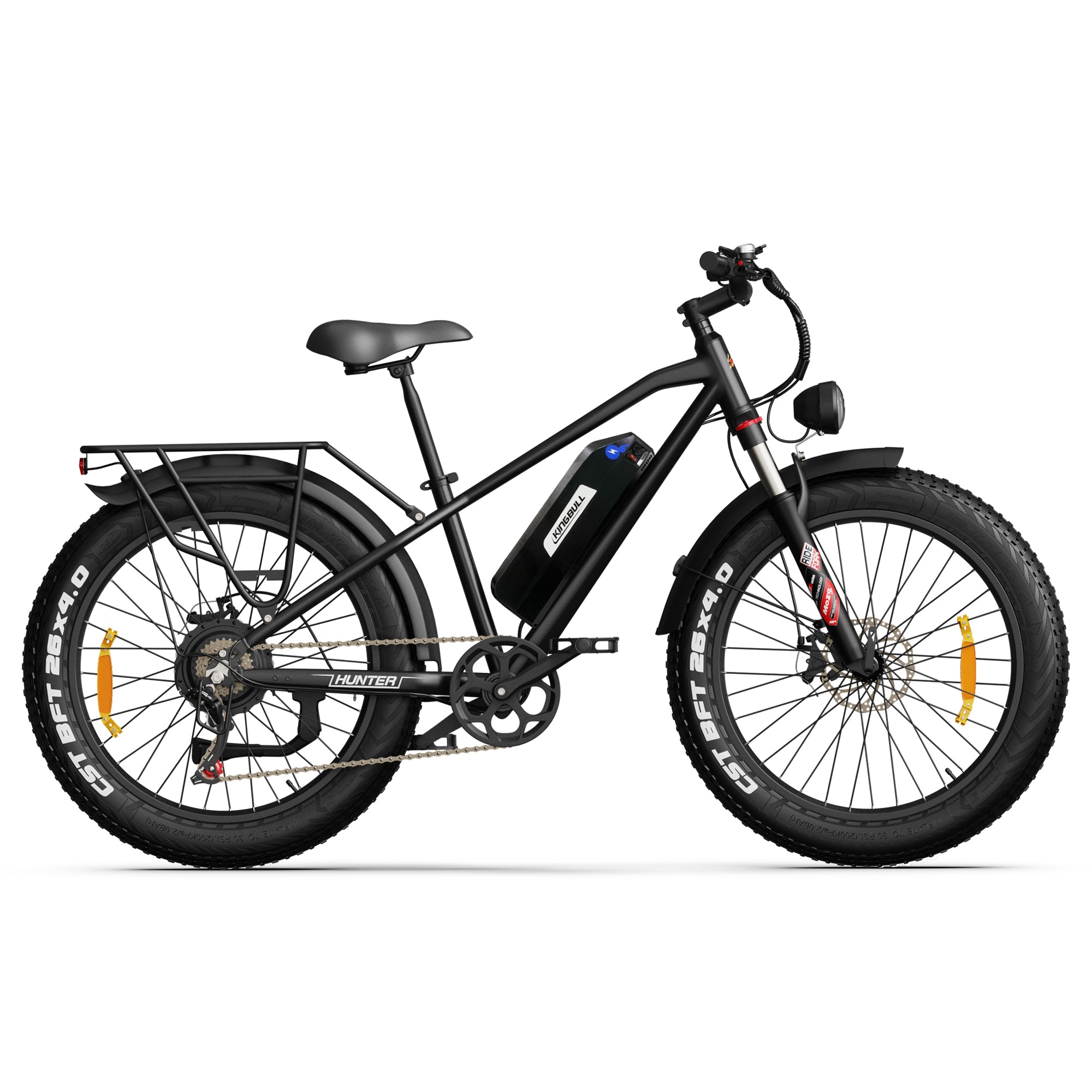
The Hunter 2.0 is $779.00, down from $1,699.00. The hardware is legitimately good for the money. The range claim needs translating.

Published specification
| Specification | Value |
|---|---|
| Motor | 750 W brushless hub motor, 80 Nm torque (1300 W peak) |
| Battery | 48 V / 720 Wh (15 Ah) lithium-ion |
| Controller | 48 V / 22 A |
| Tyres | 26" x 4" fat tyres |
| Brakes | 2-piston hydraulic disc, power-off brake levers |
| Fork | Hydraulic spring, 80 mm travel, lockable, tapered steerer |
| Stated range | 55 miles (under ideal riding) |
| Payload capacity | 400 lbs |
| Rear rack capacity | 150 lbs |
| Bike weight | 79 lbs (per Kingbull's comparison table) |
| Total length / height | 74.4 in (189 cm) / 43.7 in (111 cm) |
| Seat height | 32.3 in to 39.4 in (82-100 cm) |
| Lighting | 48 V LED headlight, tail light with brake light, horn |
| Warranty / returns | 2 years / 15 days |
| Shipping | Free, ships from US warehouse within 2 days |
| Price | $779.00 (regular $1,699.00) |
Do the range maths yourself - it takes ten seconds
Battery capacity is in watt-hours. This bike has 720 Wh. Energy consumption on an e-bike is measured in watt-hours per mile, and for a heavy fat-tyre bike with a 750 W hub motor the realistic figures are roughly:
- 15-20 Wh/mile if you pedal genuinely hard on low assist, flat ground, no wind
- 25-35 Wh/mile at moderate assist with normal riding
- 40-50 Wh/mile on throttle only, or on soft sand and hills - which is exactly what fat tyres are for
Divide 720 by each of those and you get roughly 36-48 miles at the optimistic end, 21-29 miles in normal riding, and 14-18 miles on throttle in the conditions this bike is marketed for. Kingbull's 55-mile figure requires around 13 Wh/mile, which means a light rider pedalling most of the work on the lowest assist setting on flat tarmac. Their own wording - "under ideal riding" - concedes this.
None of that makes it a bad battery. 720 Wh is a genuinely large pack at this price; many $1,000 e-bikes ship 500 Wh. It just means you should plan around 25-30 miles of real mixed riding, and then you will never be caught out.
Where the money clearly went
- Hydraulic disc brakes, two-piston. This is the standout. On a 79 lb bike carrying a rider at 20 mph, mechanical cable discs are genuinely inadequate, and most sub-$1,000 e-bikes ship them anyway. Hydraulics at this price is a real safety upgrade, not a spec-sheet flourish.
- 80 Nm of torque is what actually matters for climbing and soft ground - more relevant than the headline wattage.
- 400 lb payload with a 150 lb rear rack rating. Unusually high, and honestly published.
- A lockable 80 mm fork with a tapered steerer. Lockout means you are not wasting energy bobbing on tarmac; a tapered steerer is a stiffer, better front end than the straight steerers common at this price.
- 2-year warranty, US warehouse dispatch in 2 days. Both meaningful when a bike needs a warranty claim or a spare part.

Three honest drawbacks
1. No battery safety certification is stated anywhere on the listing. This is the most important gap. E-bike battery fires are a genuine and well-documented hazard, and the recognised standards are UL 2271 for the battery pack and UL 2849 for the complete electrical system. Several US cities now restrict or ban uncertified e-bikes in buildings, and some insurers ask. The Hunter 2.0's page publishes voltage, capacity and controller amperage but does not mention certification. Ask Kingbull directly whether the pack is UL 2271 or UL 2849 certified before ordering, and treat the answer as a deciding factor rather than a detail - particularly if you will charge it inside your home.
2. 79 pounds is a lot of bike, and the 15-day return window is short. At 79 lbs this is not going onto a standard car rack or up a flight of stairs without a plan - most hitch racks rated for e-bikes handle it, most trunk racks do not. Combine that with a 15-day return period and you have a narrow window to discover whether the bike fits your life. Thirty days is the industry norm at this price. Unbox it and ride it properly in the first week.
3. The class configuration needs checking for your jurisdiction. Kingbull's page references both Class 2 and Class 3 operation with adjustable speed settings. That flexibility is useful, but it puts the compliance burden on you: what is legal on a bike path in one state or country is not in another, and a 750 W motor already exceeds the legal limit in the UK, the EU and several other markets. Confirm what your local law allows and how the bike must be configured before you ride it anywhere public.
One further note on price: $779 against a $1,699 reference is a 54% reduction, and Kingbull runs frequent promotions. Judge it against other 750 W fat-tyre bikes at around $800 - where it competes well - rather than against the anchor.
Who should buy it - and who should not
Buy it if you want a capable, genuinely powerful fat-tyre bike for trails, sand, snow or rough commuting, you have ground-floor or garage storage, and you can confirm the battery certification. The hydraulic brakes, 80 Nm torque and 720 Wh pack are a strong combination at $779 - that is the specification you would normally pay $1,200 for.
Skip it if you need to carry the bike up stairs or onto a light car rack, if you are outside the US where 750 W is likely illegal on public roads, if you were relying on the 55-mile figure, or if Kingbull cannot confirm UL certification for the pack.
Verdict
Component-for-component this is a lot of e-bike for $779 - hydraulic brakes and a 720 Wh battery are the two things budget e-bikes usually skimp on, and Kingbull skimped on neither. The published payload and dimensions show a brand willing to give real numbers. The range claim is optimistic in the standard industry way, the return window is tight, and the absence of any battery certification statement is the one thing I would resolve before spending the money.
Current pricing and colour options are on the official Kingbull store, and our brand overview is on the kingbullbike store page.
Disclosure: this article contains affiliate links. If you buy through them we may earn a commission at no extra cost to you. All specifications and prices were taken from the manufacturer's official product page and are subject to change. Range figures in this article are illustrative estimates based on published battery capacity, not measured results. Always wear a helmet and check local e-bike laws before riding.