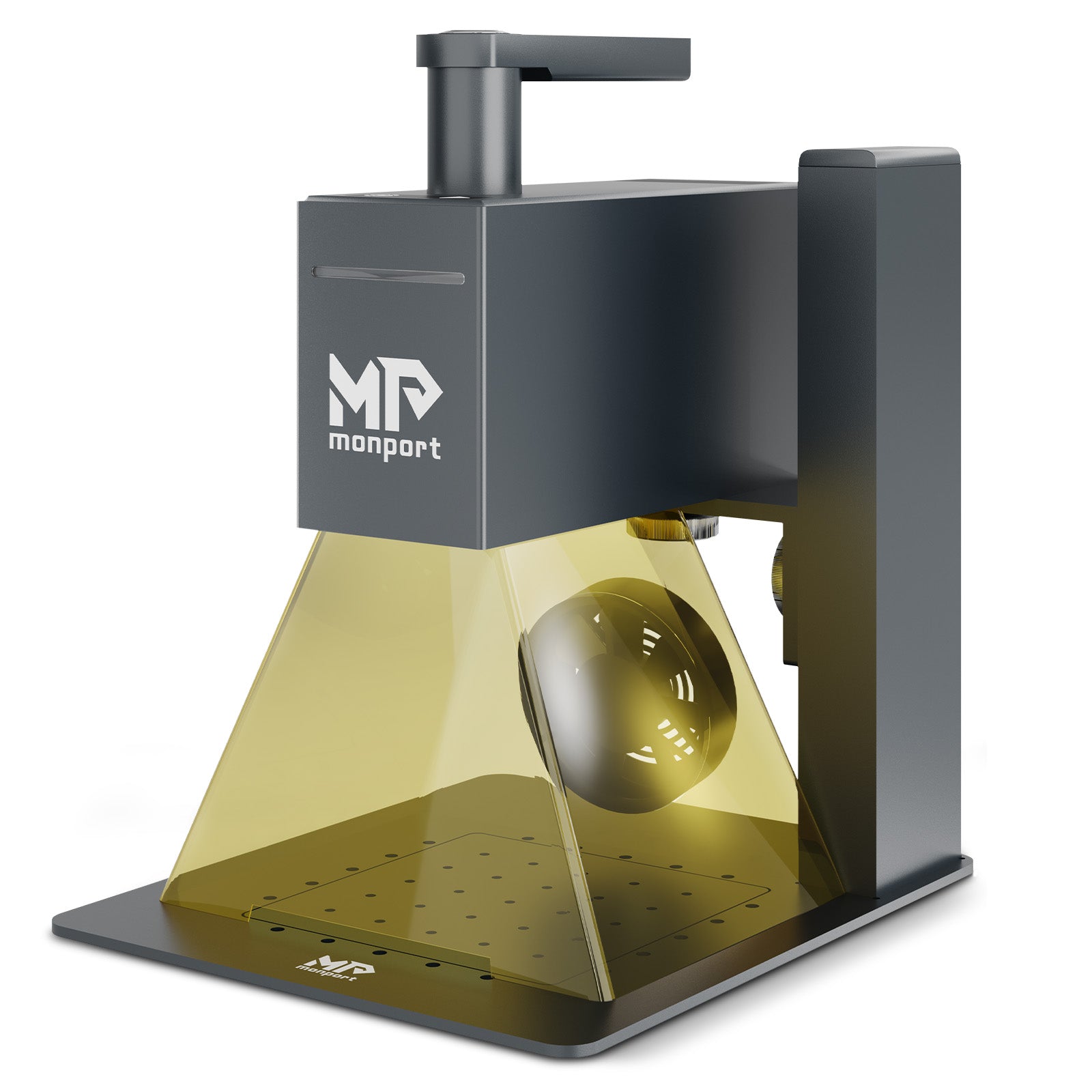
I build and specify small-format laser systems for makers and small production shops, and the question I get asked more than any other is some version of "can I skip the big enclosed machine?" Handheld diode engravers are the reason that question keeps coming up. The Monport 6W Handheld Diode Laser Engraver is one of the more seriously specified entries in that category, and its spec sheet answers the question more honestly than most marketing does.

Full Specifications
| Laser power | 6W |
|---|---|
| Laser wavelength | 450nm (blue diode) |
| Laser source | One diode laser with FAC |
| Working area | 100 × 100 mm |
| Cutting depth | 6 mm |
| Engraving precision | 0.05 mm |
| Engraving speed | 600 mm/s |
| Preview speed | 17,000 mm/s |
| Resolution | 3.3K |
| Diode lifespan | 10,000+ hours |
| Power adapter | Input AC 100–240V 50/60Hz 1.7A; output 12V–4A, 48W |
| Supported systems | Windows, macOS |
| Certifications | CE, FCC, RoHS |
| Product volume | 205 × 179 × 249 mm |
| Net weight | 2.55 kg (gross 3.9 kg) |
| Warranty | One year |
| Price | $599.99 (regular price $1,099.99), free shipping |
What the Numbers Actually Tell You
0.05mm precision is the headline figure, and it is the right one
For a portable unit, 0.05 mm engraving precision is the specification that determines whether output looks like a product or like a craft-fair experiment. At that resolution, small text, serialisation marks and fine line art hold together. Paired with a stated 3.3K resolution and a 450 nm blue diode with FAC (fast-axis collimation, which tightens the beam profile), this is a machine built around detail work rather than bulk material removal.
The 17,000 mm/s preview speed is a usability feature
Preview speed is easy to dismiss as a marketing number, but at 17,000 mm/s the frame outline is effectively instantaneous, which means aligning a job on an irregular object stops being a guessing game. On a portable engraver — where you are placing the machine onto the workpiece rather than the other way around — fast, confident framing is most of the workflow.

6 mm cutting depth sets a realistic ceiling
Monport quotes a 6 mm cutting depth. That is a genuinely useful figure for plywood, acrylic, leather and card, and it puts small enclosure panels, tags and inlays within reach. It is also a hard boundary: this is not a machine for furniture-scale cutting, and pretending otherwise is how people end up disappointed.
Four Limitations Worth Understanding Before You Buy
1. The 100 × 100 mm working area is small — genuinely small
Ten centimetres square is roughly a coaster. Anything larger has to be tiled by repositioning the machine, and tiling on a handheld unit means you are responsible for the alignment between passes. If your typical job is a laptop lid, a sign or a cutting board, this is the specification that should give you pause.
2. 6W of blue diode is not a metal-cutting machine
A 450 nm diode at 6 W is well suited to marking and engraving, and it is a completely different tool from a fibre laser when it comes to bare metal. Monport itself sells fibre and CO₂ machines precisely because those jobs need a different source. Buy this for portability and detail, not as a substitute for a fibre marker.
3. "Handheld" at 2.55 kg means handheld in bursts
Net weight is 2.55 kg in a 205 × 179 × 249 mm body. That is easy to carry to a job and easy to set down onto a workpiece — it is not something you hold steady in mid-air for a long engraving pass. Plan on placing it on the surface, not gripping it.
4. Open-frame operation puts safety entirely on you
CE, FCC and RoHS certification covers the product; it does not enclose the beam. An open-frame diode laser demands proper wavelength-rated eye protection for everyone in the room, ventilation appropriate to the material, and a fire-aware setup. An enclosed desktop machine forgives lapses. This one does not.
Who This Machine Is For
- On-site personalisation businesses — markets, pop-ups, events — where the machine has to travel and the jobs are small.
- Makers who need to mark assembled objects that will never fit inside a desktop enclosure.
- Small-batch producers doing serial numbers, logos and tags where 0.05 mm precision is the requirement and 100 mm is enough canvas.
- Anyone adding a second, portable machine alongside an existing enclosed CO₂ or fibre setup.
Who Should Look Elsewhere
- Anyone whose work is bigger than a coaster. A fixed-bed machine with a real work envelope will frustrate you far less.
- Bare-metal engravers. You want a fibre source, not a 6 W diode.
- Shared or classroom spaces where an open beam path is not appropriate.
- Buyers expecting production throughput. At 600 mm/s engraving speed on a 100 mm bed, this is a precision tool, not a volume one.
Verdict
The Monport 6W handheld is a specialist, and it is refreshingly clear about being one. The specification set — 0.05 mm precision, 6 mm cutting depth, 3.3K resolution, 17,000 mm/s framing, 10,000+ hour diode life, one-year warranty — describes a portable detail engraver, and within that brief the numbers are strong. At $599.99 against a $1,099.99 regular price with free shipping, it is priced as a serious tool rather than a novelty. The deciding factor is not quality; it is geometry. If 100 × 100 mm covers your work, this is a compelling machine. If it does not, no amount of precision will make up the difference, and Monport's fixed-bed range is the better conversation.
Check current Monport laser engraver pricing and stock here.
For the full range of current deals, see the Monportlaser store page on our site, or go straight to the official Monport store.
Disclosure: this article contains affiliate links. If you buy through them we may earn a commission at no additional cost to you. All specifications and prices were taken from the official product listing at the time of writing and are subject to change.