Self-tanning chemistry is simpler than the marketing suggests, and understanding it makes you a much better shopper. Essentially every self-tanner on the market - budget or luxury, "clean" or conventional - works through one molecule: DHA, dihydroxyacetone. It is a simple sugar that reacts with amino acids in the outermost dead layer of your skin, producing brown melanoidin pigments. That is a Maillard reaction: the same chemistry that browns bread crust.
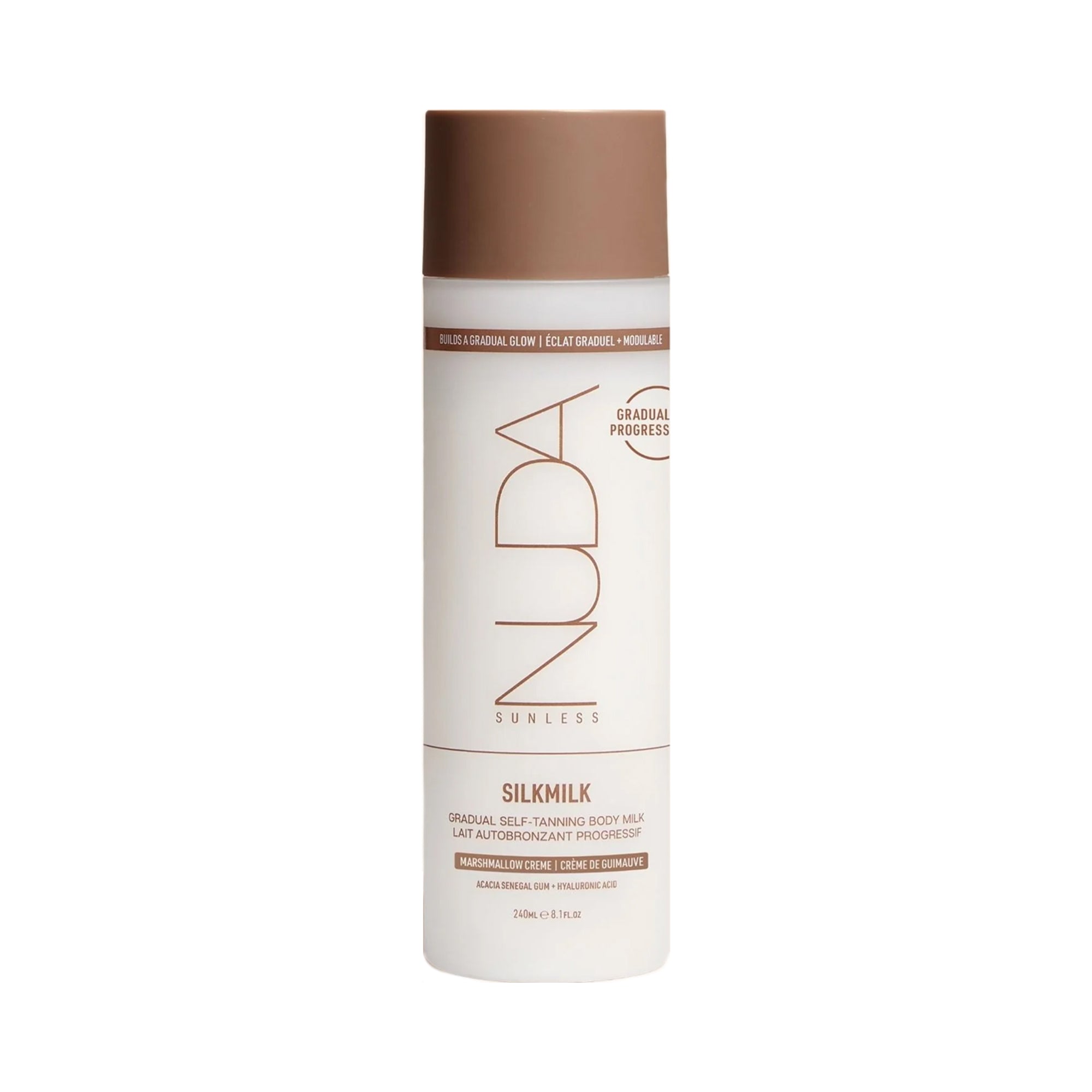
Which means the interesting question about any self-tanner is never the DHA. It is everything else in the bottle. NUDA SilkMilk Gradual Self Tanning Body Milk, $39.00 for 8.1 oz at Planet Beauty, has a genuinely well-considered supporting formula - and one combination I think works against itself.

Published specification
| Specification | Value |
|---|---|
| Product type | Gradual self-tanning body milk / tan extender |
| Size | 8.1 oz |
| Active tanning agent | Naturally derived DHA |
| Hydration actives | Hyaluronic acid, panthenol, squalane |
| Barrier actives | Plant-based ceramides |
| Tone actives | Niacinamide, bakuchiol |
| Other | Vegan collagen, botanical extracts |
| Naturally derived content | 92% stated |
| Free from | Parabens, sulfates, phthalates |
| Application | No rinse required; buildable; non-transfer once dry |
| Brand | Nuda Canada |
| Price | $39.00 |
Why the supporting formula is the reason to consider it
Conventional self-tanners have a well-earned reputation for being drying, and there is a mechanical reason. DHA reacts with the stratum corneum, and the alcohol-heavy quick-dry bases most tanners use strip lipids on the way. Dry skin then sheds unevenly, and uneven shedding is exactly how a tan goes patchy at the ankles, knees and elbows.
NUDA has attacked that problem specifically, and the ingredient choices are correct:
- Hyaluronic acid and panthenol are humectants - they hold water in the upper skin layers, which keeps the corneocytes plump and shedding evenly.
- Squalane is an emollient that mimics skin's own lipids, absorbing without residue.
- Ceramides are barrier lipids. A healthy barrier sheds gradually and predictably, which is precisely what a fading self-tan needs.
- Niacinamide supports barrier function and is one of the better-evidenced actives in cosmetic science generally.
Taken together, that is not a random list of trendy ingredients - it is a coherent strategy for making a tan fade evenly rather than in blotches. The gradual, no-rinse format supports the same goal: you build colour over several days, so a mistake is a slightly uneven layer rather than a disaster, and you can stop at your own shade.

Three honest drawbacks
1. Bakuchiol and DHA are working against each other. This is the interesting one. Bakuchiol is a plant-derived retinol alternative, and a core part of what it does is encourage cell turnover - moving skin cells up and off the surface faster. A DHA tan lives entirely in those outermost dead cells. Accelerate turnover and you shorten the tan's lifespan. It is not harmful and the effect is likely modest at cosmetic concentrations, but including a turnover-promoting active in a product whose whole purpose is to make surface pigment last is a curious formulation decision. If your tan seems to fade faster than expected, this is a plausible reason.
2. "Vegan collagen" is a marketing term that does very little here. Collagen is, by definition, an animal protein - so "vegan collagen" is either a yeast-fermented analogue or a plant peptide blend chosen to sound similar. More importantly, collagen molecules are far too large to penetrate intact skin in any meaningful way; topically they function as decent surface humectants, no more. There is nothing wrong with it being in the bottle, but do not let it drive the purchase. The hyaluronic acid, squalane and ceramides are doing the actual work.
3. It offers no sun protection whatsoever, and the listing does not say so. This is the safety point and it matters. A DHA tan is a surface stain; it provides essentially no meaningful UV protection - the frequently cited figure for DHA is around an SPF of 3, which is negligible. People genuinely do get burned because they felt tanned. Wear sunscreen exactly as you would with pale skin. Every self-tanner should state this plainly on the page and this one does not.
Two practical notes. At 8.1 oz used daily over the whole body, this will not last long - a full-body application is a substantial amount of product, so treat $39 as a recurring cost rather than a one-off. And the page gives no patch-test guidance; DHA is generally very well tolerated, but with bakuchiol and botanical extracts also present, testing a small area first is sensible if you have reactive skin.
Who should buy it - and who should not
Buy it if you have dry or sensitive skin and have found conventional self-tanners drying or patchy, and you want to build colour slowly with control. The barrier-support formula is genuinely well-designed for that problem, and the no-rinse gradual format is the most forgiving category of self-tan there is. It also works sensibly as a tan extender between stronger applications.
Skip it if you want deep colour fast - gradual tanners take days and this is not the product for an event tomorrow. Skip it if you are buying primarily for the "vegan collagen", if you need a shade-matched product (there is one formula, and depth is controlled by frequency, not shade selection), or if a recurring $39 for body product does not fit your budget.
Verdict
Judged on formulation, this is above average. Someone understood that the enemy of a good self-tan is an unhealthy skin barrier, and built the product accordingly - humectants, emollients, ceramides and niacinamide all pulling in the same direction. The 92% naturally derived figure and the paraben, sulfate and phthalate exclusions are a bonus rather than the point. The bakuchiol inclusion is arguably self-undermining, the collagen claim is decorative, and the absence of any sun-protection warning is a real omission. Buy it for the barrier care; wear sunscreen anyway.
Current pricing and the full range are on the official Planet Beauty store, and our overview of the retailer is on the planetbeauty store page.
Disclosure: this article contains affiliate links. If you buy through them we may earn a commission at no extra cost to you. Ingredients and prices were taken from the retailer's official product page and are subject to change. Self-tanning products do not protect against UV damage - always use sunscreen. Patch test if you have sensitive or reactive skin, and consult a dermatologist with any specific skin concern.