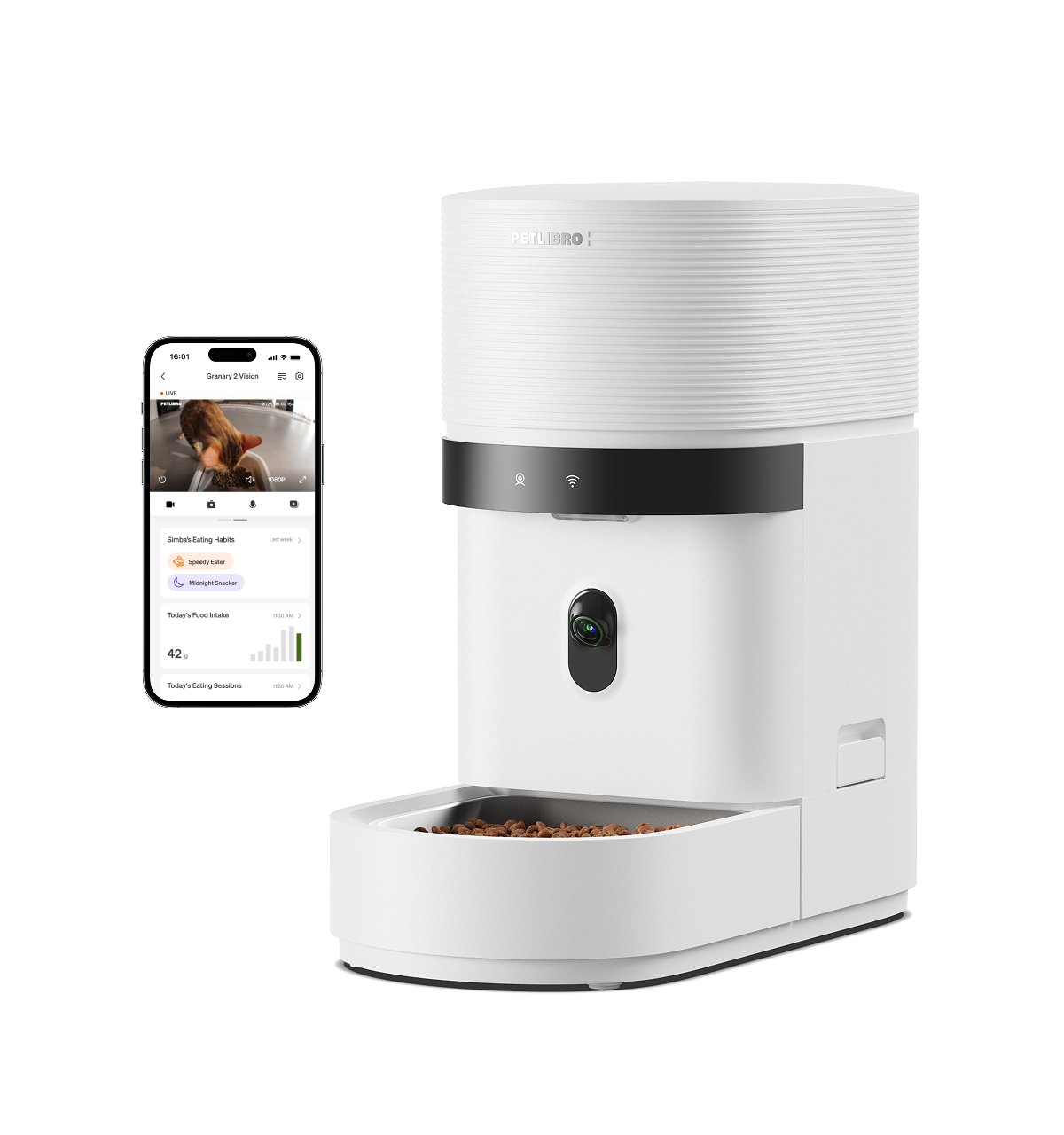
Almost every automatic pet feeder solves the wrong problem. They dispense food on a schedule, which helps you, and they tell you nothing about whether the animal ate it, which is the thing that actually matters. In a multi-cat household the single most useful piece of clinical information is which cat ate how much - because a drop in intake is one of the earliest signals of illness in cats, and it is invisible when three animals share a bowl.
That is the specific problem the PETLIBRO Granary 2 Vision Smart Feeder is built for. It is $189.99. Here is what it does, and where the listing leaves gaps.

Published specification
| Specification | Value |
|---|---|
| Weighing | Built-in bowl scale, accurate to within 1 g |
| Camera | HD camera for meal monitoring |
| Pet recognition | AI camera recognition, up to 10 cats, no collar or tag required |
| Feeding mode 1 | Smart Refill - keeps the bowl automatically topped up |
| Feeding mode 2 | Scheduled Feeding - exact times and portions |
| Tracking | Logs dispensed, eaten and remaining food per pet profile |
| Variants | Granary 2 Vision, Granary 2 Vision Duo |
| Colours | White, Black |
| Warranty | 24 months |
| Returns | 90-day money-back guarantee |
| Shipping | Free on Granary 2 Series to contiguous US; 5-8 business days |
| Payment | HSA/FSA accepted via Flex at checkout |
| Price | $189.99 |
Why the 1-gram scale and collar-free recognition matter clinically
The bowl scale is the headline, not the camera. A feeder that dispenses 30 grams tells you 30 grams left the hopper. A feeder that weighs the bowl continuously tells you how much actually disappeared - and the gap between those two numbers is the entire point. Cats are famous for approaching food, sniffing, and walking away; that behaviour is a genuine early warning sign, and a dispensing-only feeder records it as a completed meal.
One-gram resolution is meaningful precision at these portion sizes. A typical adult cat eats somewhere around 50 to 60 grams of dry food a day. Resolution of 1 g means you can see a 10% change in intake, which is the kind of shift a vet would want to know about weeks before it becomes visible as weight loss.
Collar-free recognition solves the real-world failure of RFID feeders. The established approach to multi-pet feeding is an RFID tag on the collar. It works, right up until the cat slips its collar, the tag battery dies, or you have a cat that will not tolerate a collar at all - which is a lot of cats, and every indoor cat owner who has decided collars are a snag risk. Doing identification by camera removes the hardware from the animal entirely. PETLIBRO states this scales to 10 cats.
The two feeding modes are also well-chosen. Smart Refill suits free-feeders and grazers; Scheduled Feeding suits portion-controlled or weight-management animals. Most feeders only do the second.

What works
- Per-pet data, automatically attributed. This is the feature that changes what you can do, rather than just how convenient it is.
- 90-day money-back guarantee. Unusually long, and appropriate - you need weeks of data to know whether the recognition works reliably with your specific animals.
- 24-month warranty on a motorised, camera-equipped device.
- HSA/FSA eligibility. Genuinely unusual for a pet product, and potentially significant if you have funds to use.
- A Duo variant for households that need two feeding stations rather than one.
Four honest drawbacks
1. Key hardware numbers are not published on the listing. There is no stated hopper capacity, no dimensions, and no clear statement about battery backup. Hopper capacity determines how long you can leave the house; battery backup determines what happens to your cats during a power cut. For a $189.99 device sold on reliability, both should be on the page. Ask PETLIBRO before ordering if you travel.
2. The listing does not state whether camera features require a subscription. Camera-equipped pet devices very commonly gate video history, cloud clips or advanced insights behind a monthly plan. The page describes HD monitoring and long-term insights without saying what is included free and what is not. Assume nothing - confirm the subscription position before you buy, because it changes the real cost of ownership substantially.
3. Recognition accuracy is claimed but not quantified. "Up to 10 cats" is a capacity, not an accuracy rate. Camera-based identification is genuinely harder with visually similar animals - two black domestic shorthairs, or two grey tabbies from the same litter, are a materially harder problem than a tabby and a ginger. If your cats look alike, treat the 90-day return window as your actual test period rather than assuming it will work.
4. It is a cat product being sold to pet owners generally. Every recognition claim on the page is phrased around cats. If you have dogs, or a mixed household, the page does not tell you how the system behaves, and a bowl designed for feline portions is unlikely to suit a large dog. Also note that this needs Wi-Fi and an app; if your network is unreliable, so is the data.
A small footnote on the HSA/FSA route: PETLIBRO's own process involves a telehealth consultation and a non-refundable $5 letter-of-medical-necessity fee. Worth knowing before you assume it is a straightforward payment option.
Who should buy it - and who should not
Buy it if you have two or more cats, especially if one is on a prescription or weight-management diet, or if you have an ageing cat where early detection of appetite change is worth real money. The per-pet intake data is the product; if you need it, nothing cheaper does this.
Skip it if you have one cat and simply want food to appear on schedule - a $40 timer feeder does that job and this is four times the price for data you do not need. Skip it if your cats are visually near-identical, if your Wi-Fi is unreliable, if you have dogs, or if you need certainty about hopper capacity and battery backup before committing.
Verdict
PETLIBRO has correctly identified that the valuable output of a pet feeder is information, not food, and the combination of a 1-gram bowl scale with collar-free identification is a genuinely well-aimed piece of engineering. The 90-day return and 24-month warranty make it a reasonable risk. What lets it down is the listing: publish the hopper capacity, be explicit about battery backup, and state plainly whether the camera needs a subscription. Ask those three questions before you order.
Current pricing and variant options are on the official PETLIBRO store, and our brand overview is on the petlibro store page.
Disclosure: this article contains affiliate links. If you buy through them we may earn a commission at no extra cost to you. All specifications, warranty terms and prices were taken from the manufacturer's official product page and are subject to change. This article is consumer information, not veterinary advice - if you are concerned about your pet's appetite or weight, speak to your vet.