Display glasses have spent five years being interesting and not quite good enough. The recurring failure was always brightness: birdbath optics throw away most of the light on the way to your eye, so panels that look spectacular on a bench end up washed out the moment you use them anywhere with a window. Every other specification is downstream of that one.
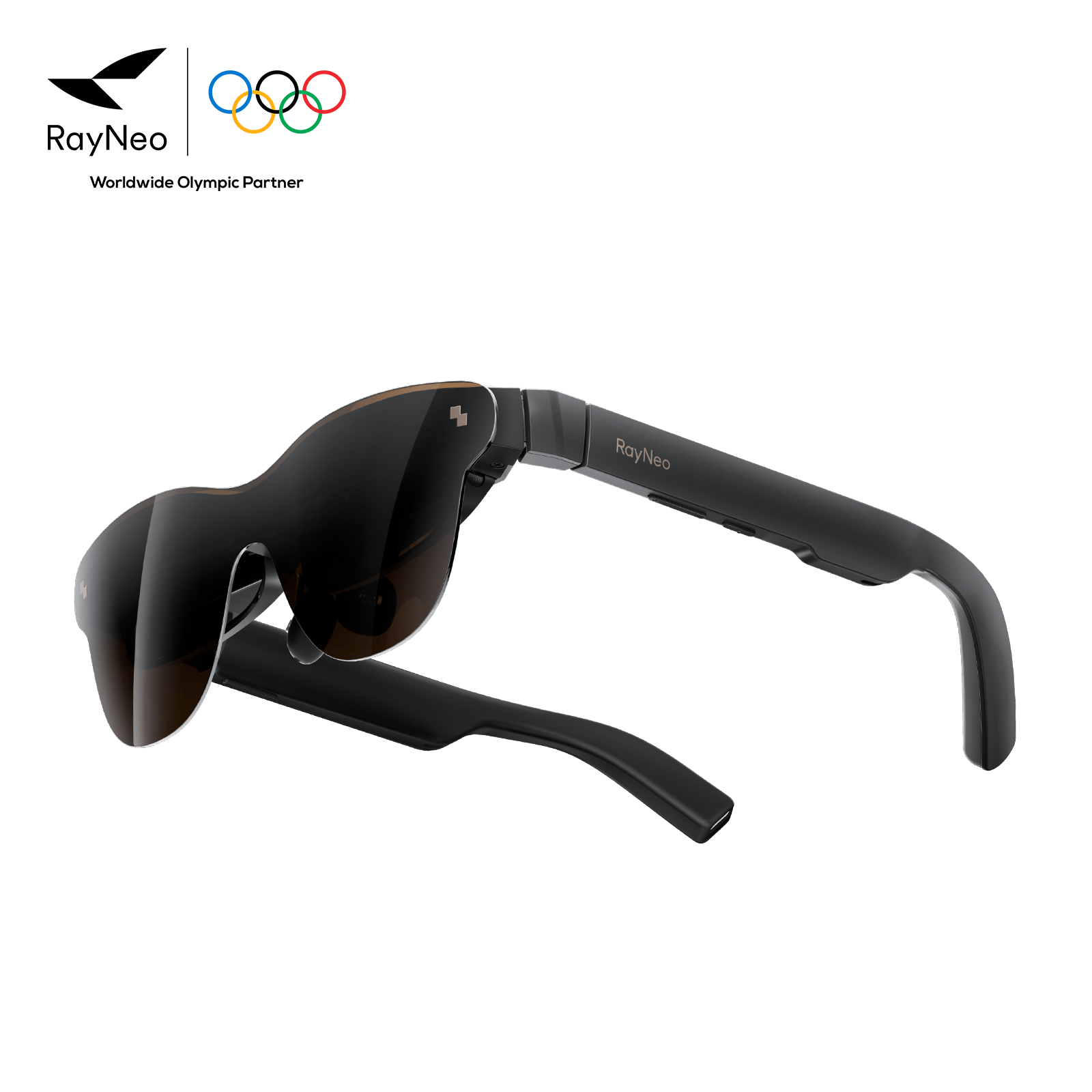
Which is why the RayNeo Air 3s Pro is worth taking seriously. At $299.00 — or $279.00 for a refurbished unit with minor cosmetic wear — RayNeo is claiming 1,200 nits to-eye brightness, which they describe as the highest in any AR glasses currently available. That is the number that decides whether these are usable on a plane at midday or only in a dark room.

The specification, as listed
| Model | RayNeo Air 3s Pro AR Glasses |
|---|---|
| Price | $299.00 new · $279.00 refurbished (minor cosmetic wear) |
| Brightness | 1,200 nits to-eye |
| Display | HueView 2.0, 5.5th-generation tandem Micro-OLED |
| Contrast | 200,000:1 |
| Colour | 98% DCI-P3 |
| Virtual screen | 201 inches at 6 m, 6 viewing modes |
| Eye comfort | TÜV SÜD Low Blue Light and Flicker-Free dual certification |
| Dimming | 3,840Hz high-frequency PWM, 20 brightness levels |
| Audio | Quad-speaker with spatial audio, Whisper Mode private listening |
| Weight | 76 g, 46.7% : 53.3% weight distribution |
| Fit adjustment | Temples 9 levels, nose pads 3 levels |
| Compatibility | iOS/Android with DisplayPort, Switch and Switch 2 via JoyDock, PC/PS5/Xbox via HDMI adapter |
What RayNeo has actually achieved
1,200 nits changes where you can use them
Brightness is the whole ballgame in this category, and this is a large claimed figure. RayNeo frames it in terms of shadow detail — being able to see faint stars in a dark scene rather than a black smear — which is the correct way to think about it. Higher to-eye brightness means you can run the panel comfortably in a lit cabin or a bright living room instead of hunting for darkness.
The panel specifications are top-tier
Tandem Micro-OLED with a claimed 200,000:1 contrast ratio and 98% DCI-P3 coverage is a genuinely high-end display stack. Tandem OLED — stacking emissive layers — is the same approach used to get brightness and longevity up in premium tablets, and it is the right engineering answer to the birdbath light-loss problem.
The eye-comfort certifications are not marketing filler
TÜV SÜD Low Blue Light and Flicker-Free dual certification, plus 3,840Hz PWM dimming, is the most concrete thing on this entire spec sheet. Low-frequency PWM is a real cause of headaches and eye strain for sensitive users, and 3,840Hz is high enough to be a non-issue for almost everyone. For a product you wear directly against your eyes for a two-hour film, this deserves more attention than it usually gets.
76 g with published weight distribution
Most brands quote weight. Very few quote the front-to-back balance, and on head-worn hardware, balance determines comfort more than raw mass does. Publishing 46.7% : 53.3% alongside nine temple positions and three nose pad levels suggests RayNeo took fit seriously rather than shipping one size and hoping.

Where I would slow you down
1. No resolution and no field of view
The listing goes deep on brightness, contrast and colour, and never states the per-eye resolution or the field of view. FOV is the specification that determines how big that 201-inch screen actually feels and how much you have to move your eyes to read subtitles at the edges. Its absence from an otherwise detailed spec sheet is conspicuous, and resolution matters just as much if you plan to use these as a monitor for text rather than video.
2. The $299 price is not the price for consoles
Read the compatibility line carefully. Phones and laptops with DisplayPort over USB-C connect directly. Nintendo Switch and Switch 2 need the JoyDock, listed separately at $89.00. PC, PS5 and Xbox need an HDMI-to-glasses adapter and charging adapter, and RayNeo lists a USB-C adapter at $35.00. If you are buying these primarily for console gaming, the realistic entry price is closer to $388 than $299.
3. No battery means a tether, always
These glasses draw power and signal from the host device — that is why charging adapters appear throughout the accessory line. There is no cutting the cord and no independent battery life figure, because there is no battery. It also means your phone or handheld is powering a bright Micro-OLED panel, which will shorten its runtime meaningfully.
4. Nothing stated about prescription support
Nine temple levels and three nose pad levels address fit, not vision. There is no mention of dioptre adjustment or prescription lens inserts in the product description. If you wear glasses, confirm what RayNeo offers before ordering, because this is a common and expensive surprise in this category.
5. "Only" and "world's brightest" are moving targets
Claims to be the brightest available and the only glasses with dual TÜV certification are competitive claims in a fast-moving category. They may well be accurate today. They are not the kind of specification you should expect to hold for the life of the product.
Who should buy these
- Frequent flyers and commuters. A 201-inch private screen in a plane seat is the strongest use case in this whole category, and 1,200 nits is what makes it work in a lit cabin.
- People who want a big screen without a big room. Cheaper and far more compact than a projector or television.
- Anyone sensitive to screen flicker. The 3,840Hz PWM and TÜV certifications are the most compelling reason to choose these over a rival.
- Handheld gamers on Switch or Switch 2. Provided you budget for the JoyDock.
Who should wait
- Anyone wanting productivity and text work. Without published resolution and FOV, do not assume these replace a monitor.
- Console players on a tight budget. The adapters push the real cost past $380.
- Glasses wearers. Check prescription support before you order.
- Anyone expecting true augmented reality. These are a wearable display, not a spatial computing device — there is no environmental tracking in this specification.
Verdict
The Air 3s Pro is the most convincing argument I have seen for display glasses at this price. RayNeo attacked the category's real weakness — brightness — with a tandem Micro-OLED stack and a 1,200 nit claim, then backed it with contrast, colour and eye-safety certifications that most competitors do not bother to obtain. At $299, or $279 refurbished, the display hardware is not the compromise here.
Go in clear-eyed about two things: the accessory tax if you are gaming on a console, and the specifications RayNeo chose not to print. Resolution and field of view are absent from an otherwise unusually detailed listing, and in this category that omission usually means those numbers are adequate rather than exceptional. For film and streaming on the move, that is fine. For replacing a monitor, get the figures first.
Current pricing, including the refurbished option, is listed on the RayNeo store, and our RayNeo store page tracks their other live offers.
Disclosure: this article contains affiliate links. If you buy through them we may earn a commission at no additional cost to you. All specifications and prices were taken from the manufacturer product listing at the time of writing and may change.