Buy-one-give-one brands ask you to accept a claim you cannot verify, so the honest thing a reviewer can do is check the arithmetic that is published and be clear about what is not. Rice Love makes a specific, numerical promise, and unusually, the numbers hold together.
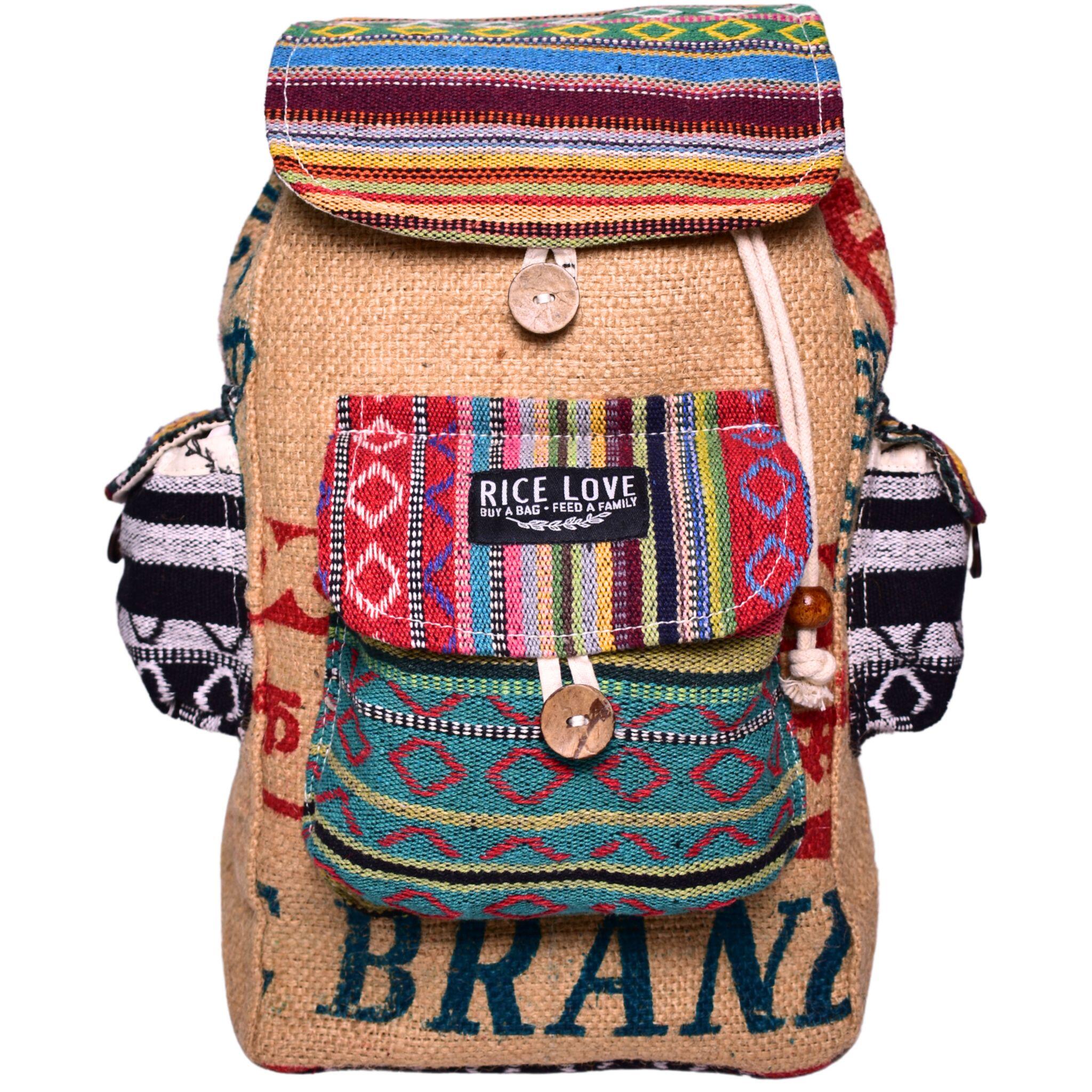
The Rice Love Mini Recycled Travel Backpack — the Agra Special edition — costs $49.50, reduced from $55.00. It is made from upcycled Indian rice sacks, and every bag sold sends a kilogram of rice to a family. Here is what checks out, and what the listing does not tell you about the bag itself.

The specification, as listed
| Product | Mini Recycled Travel Backpack — Agra Special |
|---|---|
| Price | $49.50 (was $55.00) |
| Material | Upcycled jute / burlap from authentic Indian rice bags |
| Edition | Limited run with black pockets, no restocks |
| Variation | Each bag unique; slight imperfections expected |
| Donation | 2.2 lb (1 kg) of rice per bag sold |
| Labour | Fair wages, safe conditions, no child labour |
| Dimensions · capacity · weight · lining | Not stated |
The donation maths checks out
Rice Love says each bag provides 1 kg of rice, enough to feed a family of four for a day, and that they donate in batches — 25 bags meaning 25 kg, feeding a family for about a month.
Run it: a kilogram of uncooked rice divided among four people is 250 g each, which cooks to roughly 700–750 g per person. That is a substantial staple portion for a day, so the per-day claim is reasonable rather than inflated. And 25 kg at 1 kg per day is 25 days — which is fairly described as "about a month" rather than stretched into a bigger number.
That internal consistency matters. A great many impact claims fall apart the moment you divide one figure by another, and this one does not. Credit where it is due.
What is not verifiable
No distribution partner is named, no charity or NGO is credited, and no impact report is referenced. For a brand whose central proposition is the donation, naming who actually delivers the rice — and publishing an annual total — would move this from a credible claim to a verified one. Similarly, "fair trade" is stated as a practice rather than a certification: no Fair Trade Certified mark, no WFTO membership, no auditing body. These may all exist; the listing does not say.
What is genuinely good about the product
Upcycled jute is a real material story, not a gesture
These are actual used rice sacks — printed, worn, and diverted from waste. That is materially different from a bag made of new fabric with a sustainability label attached. It also explains the variation: the graphics on each bag come from whatever sack it was cut from, so no two are the same.
Honesty about imperfections
The listing tells you plainly to expect slight imperfections and variations in pattern, and that you will get the same colour scheme rather than the exact bag pictured. Setting that expectation up front is the right way to sell upcycled goods, and it heads off the most common complaint.
The origin of this edition is charmingly told
A production error put the wrong pattern on a batch, giving them black pockets, and rather than scrapping them Rice Love sold them as a limited edition at 10% off. That is both a sensible commercial decision and exactly the right instinct for a company built on not wasting things.
Jute is genuinely biodegradable
Unlike recycled polyester, which is a better use of existing plastic but still plastic, jute breaks down. For a brand making environmental claims, the material choice supports them.

What the listing does not tell you about carrying things
1. No dimensions and no capacity
It is called a "Mini" backpack and that is the only sizing information. No height, width or depth, and no capacity in litres. You cannot tell whether a 13-inch laptop fits, whether it takes a day's worth of gear, or whether it is essentially a large purse with two straps.
2. Nothing about water resistance — and jute is not
This is the practical issue. Raw jute and burlap are coarse, open-weave natural fibres. They absorb water readily, they take a long time to dry, and prolonged damp encourages mildew in natural fibre. Whether this bag has an internal lining or any coating is not stated anywhere.
If it is unlined jute, it is a fair-weather bag — fine for a market run or a festival, poor for commuting in a rainy climate with anything electronic inside. That is not a criticism of the material choice; it is information the listing should provide.
3. No weight, no strap detail
Jute is heavier than nylon for the same area. Backpack comfort comes down to strap width and padding, and neither is mentioned.
4. No hardware specification
Zips and buckles are the first things to fail on any bag. Nothing is said about either.
5. No care instructions
Jute cannot go in a washing machine — it weakens when saturated and agitated, and it shrinks. Spot cleaning is almost certainly the answer, and the listing should say so.
6. Jute sheds, initially
Worth knowing rather than a fault: new jute products commonly shed loose fibres for the first few weeks. It settles down.
Who should buy it
- Anyone who wants the purchase to do something. The donation claim is specific and the arithmetic holds.
- People who like genuinely unique objects. Every bag carries different printed graphics from a different sack.
- Light, dry-weather use. Markets, festivals, day trips, campus.
- Buyers who value biodegradable materials. Jute is the real thing.
Who should not
- Commuters carrying electronics. Not until water resistance and lining are confirmed.
- Anyone who needs a known capacity. No dimensions published at all.
- People who want the exact bag in the photo. Rice Love says clearly you will not get it.
- Buyers who require certified fair trade. Claimed as practice, not certification.
Verdict
I came to this expecting to pick apart an impact claim and instead found one that survives a calculator. One kilogram of rice per bag, 25 kilograms feeding a family for around a month — those figures are consistent with each other and with what a kilo of rice actually provides. Combined with genuinely upcycled material and honest expectation-setting about imperfections, this is a more credible mission product than most.
The gap is the bag. There is not one dimension, no capacity, no weight, no lining information and no care guidance on the page — which means you know exactly what your $49.50 does for someone else and almost nothing about what it does for you. Ask Rice Love for the measurements and whether it is lined before ordering, and ask who distributes the rice while you are at it. Good answers would make this an easy recommendation.
The current range is listed on the Rice Love store, and our Rice Love store page tracks their other live offers.
Disclosure: this article contains affiliate links. If you buy through them we may earn a commission at no additional cost to you. Specifications, prices and donation claims were taken from the retailer listing at the time of writing and may change. We have not independently verified the donation programme.