Let me start with the word that needs addressing. Curtains cannot soundproof a room. Soundproofing means blocking sound transmission, which requires mass, sealing and structural decoupling — walls, glazing, door seals. What heavy curtains actually do is absorb sound within a room, damping reflections and reverberation, and they do it mostly at mid and high frequencies.
That is a real and useful effect. A room with heavy drapes sounds calmer, speech is clearer, and the echo off hard glass disappears. It is not the same as keeping traffic noise out, and the distinction matters if noise is why you are spending the money.
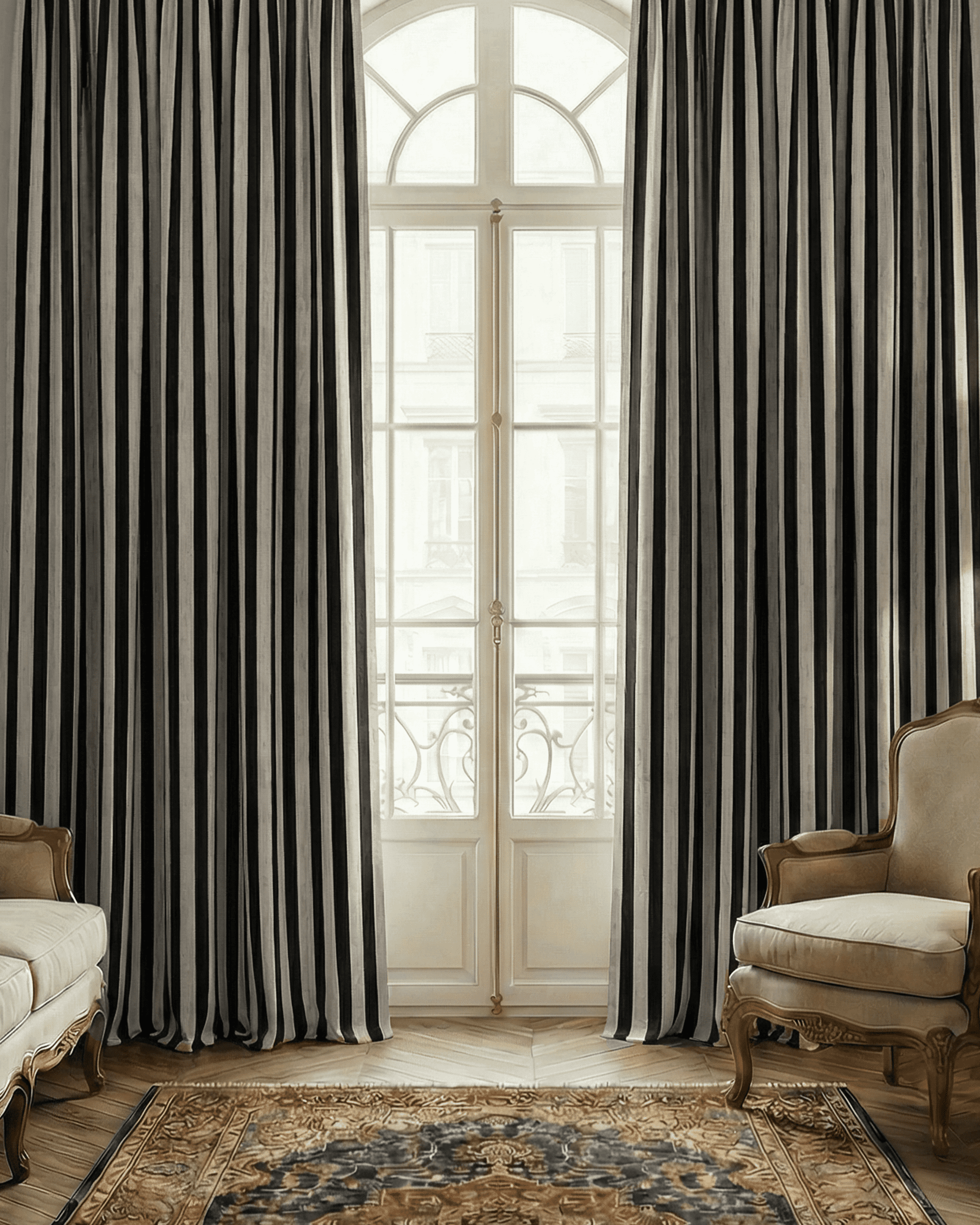
The TheHues Liam 4-Layer Soundproof Thermal Curtain lists at $143.00 in Zebra or Brown, as a made-to-measure curtain. Here is what it likely does well, and what the listing needs to tell you first.

The specification, as listed
| Product | Liam 4-Layer Soundproof Thermal Striped Linen Blend Custom Curtain |
|---|---|
| Price | $143.00 |
| Colours | Zebra, Brown |
| Construction | Four layers |
| Fabric | Linen blend, striped |
| Claims | Acoustic damping · thermal barrier · 100% blackout |
| Sizing | Custom |
| Elsewhere in the range | Café curtain $99 · patterned sheer $155 · Roman shades $253–$297 |
| Fabric composition · weight · header type · pricing basis | Not stated |
Before anything else: what does $143 buy?
This is a custom curtain brand — sizes are made to your window. The listing shows a single price with no indication of what dimensions it covers, whether it is per panel or per pair, or how the price scales with width and drop.
Curtains are typically priced per panel, and a properly dressed window needs fabric two to two-and-a-half times the track width to hang with any fullness. A pair for a standard window can therefore cost double the headline figure, and a wide patio door considerably more. Before falling for the fabric, put your measurements into the configurator and look at the total — the same advice applies to any made-to-measure window covering.
What four layers actually gets you
Layering is the correct approach, and uncommon at this price
Most "blackout" curtains are two layers: face fabric and a coated backing. Four layers typically means face fabric, a blackout liner, an insulating or acoustic interlayer, and a backing. That extra mass and the air gaps between layers are exactly what improves both thermal performance and sound absorption. The physics is sound — more mass and more layers damp more energy.
Thermal performance is the strongest real claim here
Windows are the weakest thermal point in most rooms, and heavy layered drapes genuinely reduce heat loss in winter and solar gain in summer. This is well-established and measurable, and a four-layer curtain will do it noticeably better than a single-layer one. Of the three claims on this listing, this is the one I would trust most.
Linen blend is a sensible face fabric
Linen drapes with weight and a slightly irregular texture that reads as expensive, and blending it with synthetic fibre improves dimensional stability — pure linen curtains famously grow and shrink with humidity.
Custom sizing avoids the worst curtain mistake
Off-the-shelf curtains almost never fit, and curtains that stop short of the floor or the window edge undermine everything else about them. Made-to-measure solves that, and TheHues building its whole range around it is the right premise.

The claims that need numbers
1. "Soundproof" — no NRC or STC figure
As above, no curtain soundproofs anything. What can be measured is absorption, expressed as a Noise Reduction Coefficient between 0 and 1. Heavy layered drapery might reach 0.5 to 0.7 at mid frequencies, which is a genuinely useful figure and worth advertising. None is given. Without it, "soundproof" is a word rather than a performance level — and buyers hoping to block a busy road will be disappointed by any curtain.
2. "100% blackout" ignores where light actually gets in
Blackout fabric blocks light through the cloth. It does not block light around the cloth, and in a real installation the great majority of stray light enters at the sides, the top and the bottom. Achieving genuine darkness requires the curtain to extend well past the reveal, ideally with a pelmet or side channels — none of which is discussed. The fabric may well be 100% opaque; the room will not be 100% dark without the right installation.
3. No thermal figure either
Thermal performance can be quantified as an R-value or a percentage reduction in heat transfer. Neither appears, on what I think is the product's genuinely best feature.
4. "Linen blend" without percentages
Thirty per cent linen and seventy per cent polyester behaves very differently from the reverse — in drape, in breathability, in how it takes light, and in price. The ratio is not given.
5. No fabric weight
For curtains, GSM is the number that predicts hang, and it is directly relevant to both the acoustic and thermal claims, since both scale with mass. Its absence on a product sold on those two properties is conspicuous.
6. No header type
Grommet, pinch pleat, pencil pleat, rod pocket or wave — this determines what track or pole you need and how the curtain stacks back. It is a fundamental part of ordering curtains and it is not on the page.
7. Two colours, on a custom product
Zebra and Brown only. For a made-to-measure service, a two-colour range is limited.
8. No care instructions
Four-layer blackout curtains are almost always dry clean only — the coated liner does not tolerate washing — but this is not stated.
Who should buy it
- Anyone insulating a cold or hot window. This is the claim with the best physics behind it.
- People wanting a quieter-sounding room. Absorption is real, even if soundproofing is not.
- Windows that off-the-shelf sizes do not fit. Custom is the point.
- Buyers who like the linen look with real weight.
Who should not
- Anyone trying to block outside noise. No curtain will do this — address the glazing.
- Shift workers needing total darkness. Possible, but the installation matters more than the fabric.
- Anyone comparing on specification. No GSM, no composition, no NRC, no R-value.
- Buyers who need a specific header. Not stated — confirm before ordering.
Verdict
Four-layer construction on a custom curtain at $143 is a reasonable proposition, and the thermal benefit is real, well understood and probably the best reason to buy. Linen blend is the right face fabric and made-to-measure avoids the fit problems that ruin most curtain purchases.
I would just recalibrate expectations around the headline. "Soundproof" overstates what any textile can do — expect a calmer-sounding room, not a quieter one. "100% blackout" describes the cloth, not the room. Before ordering, get the fabric composition and weight, the header options, the care instructions, and above all a total price for your actual window measurements. On the numbers, this could be very good; the page simply does not provide them.
The full custom range is listed on the TheHues store, and our TheHues store page tracks their other live offers.
Disclosure: this article contains affiliate links. If you buy through them we may earn a commission at no additional cost to you. Specifications and prices were taken from the retailer listing at the time of writing and may change. Made-to-measure items are frequently non-returnable — confirm the returns policy before ordering.