A 48-inch professional range is never just an appliance purchase. It is a kitchen renovation with an appliance at the centre of it, and the people who end up disappointed are almost always the ones who costed the range and nothing else. Before I get to whether this one is good - and it is well specified - I want to be clear about what else has to happen around it.
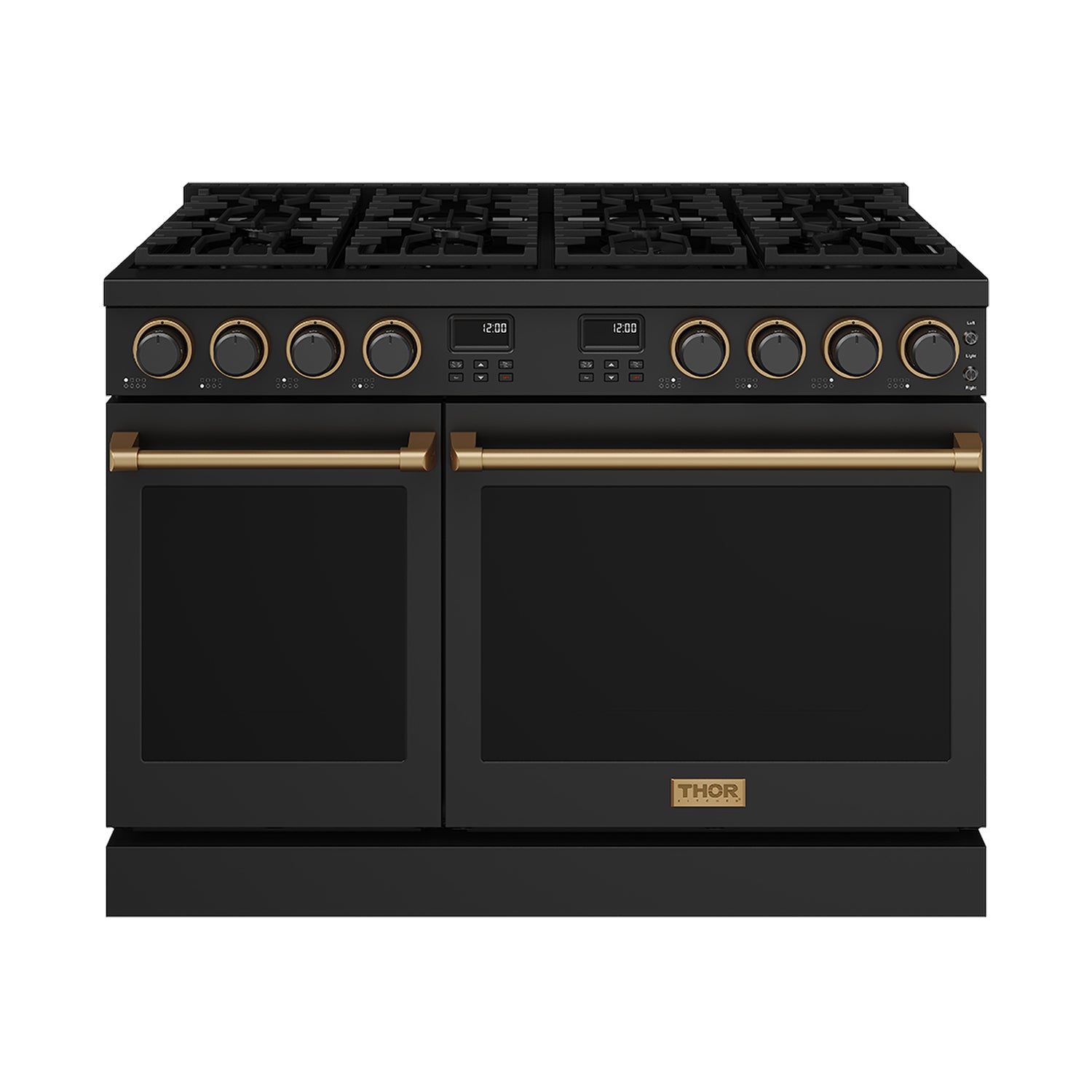
The THOR Kitchen 48-Inch Contemporary Professional Gas Range is $6,499 in natural gas and $6,699 in liquid propane, in Black/Bronze or White/Bronze. Here is the specification, then the three things that determine whether you can actually install it.

Published specification
| Specification | Value |
|---|---|
| Width | 48 inches |
| Burners | 8 sealed burners |
| Maximum burner output | 22,000 BTU |
| Minimum simmer output | 800 BTU |
| Ovens | Dual ovens |
| Total oven capacity | 7.6 cu ft |
| Convection | Convection fan fitted |
| Oven cavity | Enamel |
| Fuel options | Natural gas or liquid propane |
| Finishes | Black/Bronze, White/Bronze |
| Price | $6,499 (NG) / $6,699 (LP) |
The 22,000-to-800 BTU spread is the real headline
Everyone quotes the big number. The more revealing figure is the ratio between the two.
22,000 BTU on the power burner is genuine professional territory - enough to bring a large stockpot up fast, hold a wok at proper heat, and sear without the pan temperature collapsing when the meat goes in. Standard domestic ranges typically top out around 12,000 to 15,000 BTU, which is why home searing so often steams instead.
But 800 BTU at the simmer end is the specification I would actually pay for. Low, stable, controllable heat is much harder to engineer than high heat, and it is what lets you hold a hollandaise, melt chocolate, or keep a stock at a bare tremble without a diffuser. A range that goes to 22,000 but only down to 5,000 is far less useful in daily cooking than this spread suggests.
Dual ovens totalling 7.6 cu ft with convection is the other structural advantage of going 48 inches. Two independent cavities means roasting at 425°F and holding something at 200°F simultaneously - the actual constraint at Thanksgiving or any large dinner. One large oven, however big, cannot do that.

Three honest drawbacks
1. Ventilation is a major cost the listing does not mention, and it may be a code requirement. Eight burners totalling well over 100,000 BTU need serious extraction - professional-style ranges typically call for a hood in the region of 1,200 CFM or more. At those extraction rates many jurisdictions require a make-up air system, because pulling that much air out of a sealed modern house can backdraft other combustion appliances. A hood, ducting and make-up air can add thousands of dollars and structural work to the project. None of this appears on the product page. Speak to your installer and check local code before you commit to the range, not after.
2. Gas ranges have a documented indoor air quality cost, and this is a big one. Combustion produces nitrogen dioxide, carbon monoxide and fine particulates, and research over the past several years has linked gas cooking with elevated indoor NO2 and respiratory effects, particularly for children and people with asthma. An eight-burner range in a home kitchen produces more of all of it. This is not an argument against buying one - it is an argument for treating extraction as non-negotiable rather than optional, running the hood every time, and considering a CO alarm and adequate ventilation. If anyone in your household has asthma, factor this in seriously.
3. The listing publishes almost none of the installation data you need. There are no overall dimensions, no cutout width or depth, no required clearances to combustible surfaces, no total BTU load for sizing the gas supply line, no electrical requirement for the convection fan and igniters, no shipping weight, and no warranty term stated on the product page itself. For a $6,499 appliance that needs a plumber, an electrician and often a carpenter, that is a lot of missing information. Request the full specification sheet and installation manual from THOR before ordering - a 48-inch range frequently needs a larger-diameter gas line than an existing 30-inch range was fed with, and discovering that on delivery day is expensive.
Two smaller notes. The liquid propane version costs $200 more than natural gas, so confirm which supply you have before selecting. And the page describes an enamel oven cavity for easy cleanup but does not say the ovens are self-cleaning - at this price that is worth confirming rather than assuming.
Who should buy it - and who should not
Buy it if you are renovating a kitchen with the budget and the space to do the job properly - range, hood, make-up air, gas line - and you genuinely cook at volume. The burner range from 22,000 down to 800 BTU plus two independent convection ovens is a serious cooking specification, and THOR's positioning has long been about delivering pro-style hardware below the established luxury brands. On specification per dollar, it competes well.
Skip it if you are replacing an existing range without touching the surrounding kitchen - the ventilation and gas supply will almost certainly not be adequate. Skip it if a household member has asthma or significant respiratory sensitivity and you cannot guarantee excellent extraction, or if you cook for two most nights, in which case a good 30-inch range and $5,000 spent elsewhere in the kitchen will serve you better.
Verdict
The cooking specification is legitimately strong - the burner spread is well judged at both ends, dual convection ovens are the right reason to buy 48 inches, and the price undercuts the established professional brands substantially. What THOR does not do is prepare the buyer for the project. Get the full spec sheet, price the hood and make-up air, confirm the gas line, and go in with the true total in mind. Do that and this is a lot of range for the money; skip it and the range will be the cheapest part of an unpleasant surprise.
Both finishes, fuel options and current pricing are on the official THOR Kitchen store, and our brand overview is on the thorkitchen store page.
Disclosure: this article contains affiliate links. If you buy through them we may earn a commission at no extra cost to you. All specifications and prices were taken from the manufacturer's official product page and are subject to change. Gas appliances must be installed by a qualified professional in accordance with local codes. This article is general information, not medical advice; if you have respiratory health concerns, speak to your doctor.