There are two completely different products that get called "baby walkers," and confusing them has real consequences. Sit-in walkers — the wheeled seats a baby is placed inside — are associated with injuries serious enough that paediatric bodies have long recommended against them, and they are banned outright in Canada. Push walkers, which a standing baby holds and pushes, are a different category entirely.
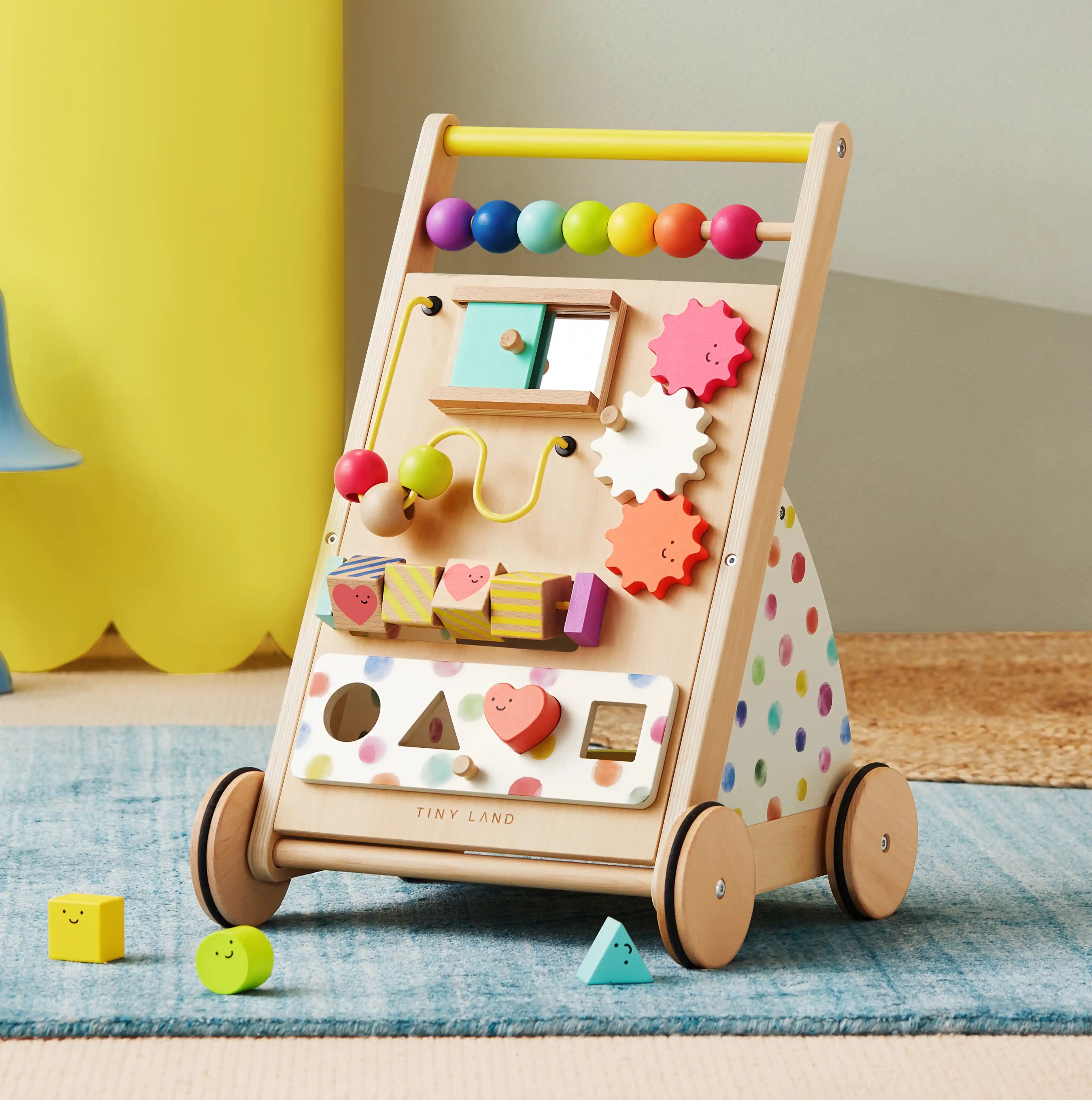
The Tiny Land Premium Natural Wooden Activity Walker is firmly the second kind, at $89.99, reduced from $95.99. It is also unusually forthcoming about safety testing and unusually quiet about some basics. Both are worth examining.

The specification, as listed
| Product | Tiny Land Premium Natural Wooden Activity Walker |
|---|---|
| Price | $89.99 (was $95.99) |
| Materials | Polished natural wood, MDF and metal components — no plastic |
| Finish | Eco-friendly varnishes and paints |
| Safety testing | CPSIA, ASTM F963-17/23, California Proposition 65 |
| Frame design | Triangular, intended to encourage upright posture |
| Speed control | Adjustable rear screws to regulate wheel resistance |
| Activity features | Knobs, gears, varied textures and sounds |
| Variants | Single configuration |
What Tiny Land does well
Naming the actual safety standards
This is the strongest thing on the listing. CPSIA is the US federal law governing lead and phthalate content in children's products. ASTM F963 is the toy safety standard covering mechanical hazards, small parts and flammability, and citing the F963-17/23 revisions shows currency rather than a decade-old certificate. Proposition 65 adds a California-specific chemical disclosure layer. Most wooden toy listings say "safe, non-toxic" and stop. Naming three specific standards is a meaningfully higher bar and it is the reason I would trust this product's finish around a teething child.
Adjustable wheel resistance is the feature that matters most
The single biggest problem with push walkers is that they run away from a new walker on hard floors — the child pushes, the walker accelerates, and they end up face-down. Screws that let you increase friction and slow the wheels, then loosen them as confidence grows, directly solve that. On a laminate or tile floor this is not a nice-to-have, it is the difference between a usable walker and one that gets abandoned in a corner.
No plastic, and it says so plainly
Wood, MDF and metal only. For parents specifically avoiding plastic in early-years toys, that is an unambiguous statement rather than a vague sustainability gesture.
The activity panel extends the useful life
Walkers get outgrown fast — often within a few months. Knobs, gears and textured elements mean the product still has value as a floor-level activity toy once walking is established, which changes the value calculation on $89.99 considerably.

What the listing does not tell you
1. No age range
For a product supporting a developmental milestone, this is the specification I most expect and it is absent. Push walkers are typically appropriate once a baby can pull to stand and cruise, generally somewhere around 9 to 12 months, but that varies enormously by child. Without a manufacturer-stated minimum age you have no guidance on whether your baby is ready, and an ASTM-certified toy still has an intended age band the maker should publish.
2. No dimensions, no weight, no maximum child weight
None of the three appear. Handle height determines whether the walker suits your child's stature. The walker's own weight determines how stable it is when leaned on — too light and it tips, too heavy and a small child cannot move it. Maximum supported weight matters because a toddler will inevitably sit or stand on it. These are basic figures for a load-bearing children's product.
3. The gait claims go further than the evidence
The listing states the triangular design means you can "say goodbye to toe-walking or bow-legged concerns." I would treat that carefully. Toe-walking and bow-leggedness in toddlers are usually normal developmental variations that resolve on their own, and where they do not, they are matters for a paediatrician rather than a toy purchase. A well-designed push walker encourages an upright stance, which is good; it is not a corrective medical device, and no product should be bought in the belief that it will fix a gait concern. If you have one, raise it with your doctor.
4. MDF sits oddly beside "premium natural wood"
Tiny Land is honest in disclosing MDF, which I respect. Be aware what it means in practice: MDF is an engineered board that is heavier than solid wood, swells permanently if it gets wet, and does not take repeated knocks to edges and corners as gracefully. On a product that will be pushed into skirting boards daily by someone learning to walk, that matters for how it ages.
5. Nothing about assembly
No indication whether it arrives built or flat-packed, and no mention of tools or time required. For a wood-and-metal product with adjustable screws, some assembly is likely.
Who should buy it
- Parents on hard floors. Adjustable wheel resistance is the reason to choose this over a cheaper walker.
- Anyone avoiding plastic toys. Clear, unambiguous material statement.
- Parents who check certifications. Three named standards is well above category norm.
- Households wanting a toy with a second life. The activity panel outlasts the walking phase.
Who should look elsewhere
- Anyone needing to confirm fit before buying. No dimensions, no handle height, no age range.
- Parents seeking a solution to a gait concern. That is a conversation for your paediatrician, not a purchase.
- Small apartments. Footprint is unpublished and wooden walkers are not compact.
- Anyone wanting solid hardwood throughout. MDF is part of the construction.
Verdict
Judged as a push walker, this is a thoughtfully built product. The named safety certifications are genuinely above average for the category, the adjustable wheel resistance addresses the real-world failure mode of push walkers directly, and the activity panel gives the toy a life beyond a three-month milestone. At $89.99 that is defensible for a wooden toy that meets CPSIA and current ASTM F963.
Two things I would want fixed on the listing. Basic dimensions and a stated age range are not optional for a product a baby leans their weight on, and the claim about resolving toe-walking and bow-leggedness overstates what any toy can do. Buy it as a well-made walker with good safety credentials, ask Tiny Land for the measurements before ordering, and take developmental questions to your doctor rather than to a product page.
Current pricing is listed on the Tiny Land store, and our Tiny Land store page tracks their other live offers.
Disclosure: this article contains affiliate links. If you buy through them we may earn a commission at no additional cost to you. Specifications and prices were taken from the manufacturer listing at the time of writing and may change. This article is not medical advice — discuss your child's development with a paediatrician, and always supervise a child using any walker.