Cellular trail cameras are subscription products wearing hardware clothing. The camera is the cheap part; the data plan is where the money goes, and any honest assessment has to start with the arithmetic over a year rather than the price on the box.
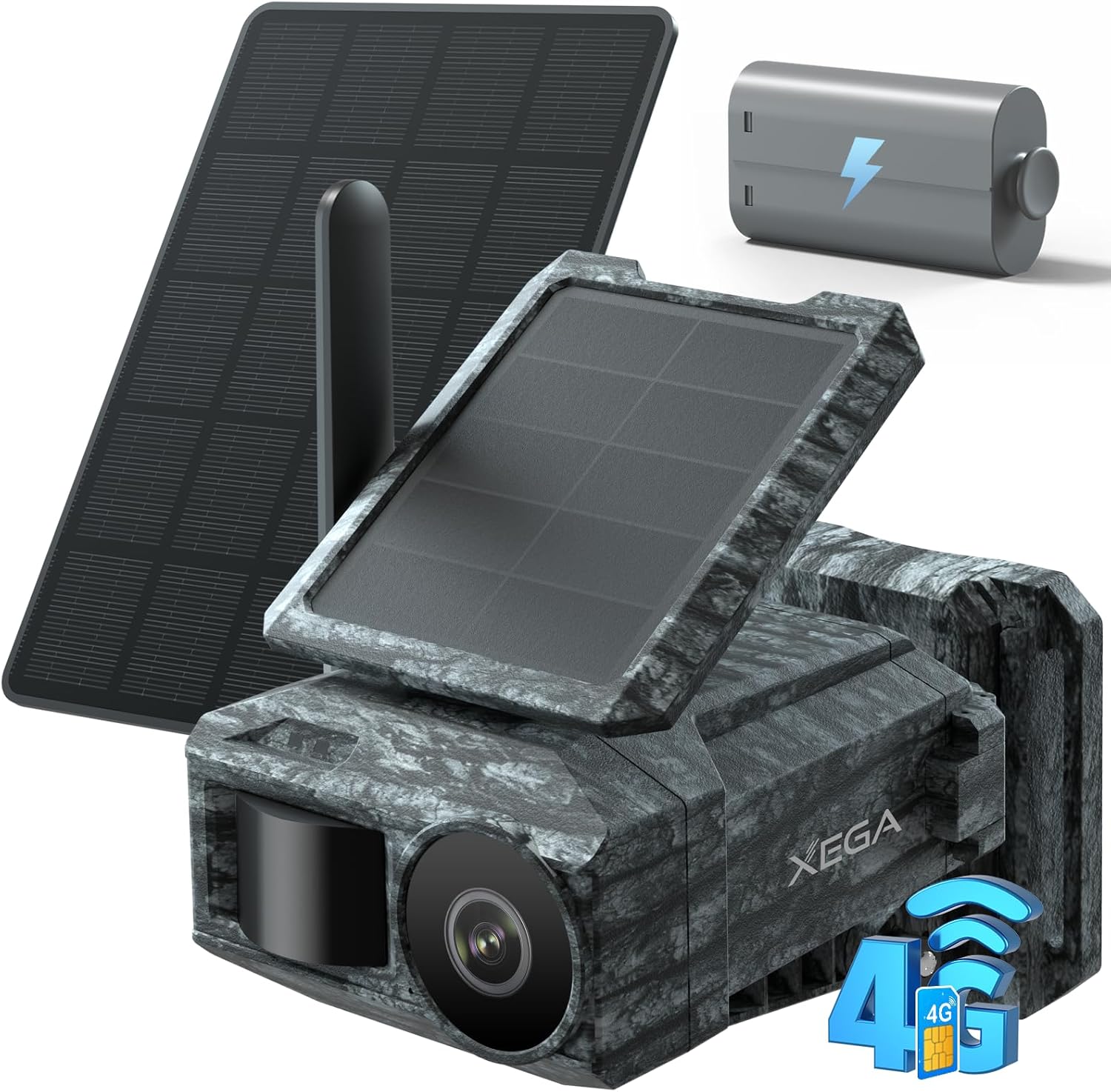
The Xega 4G Cellular Trail Camera costs $82.99, reduced from $119.99. It has a well-specified feature list — dual solar charging, 940nm invisible night vision, IP66, two-way audio, customisable detection zones. It also has a built-in SIM you cannot replace and two subscriptions, and those two facts together shape the whole purchase.

The specification, as listed
| Price | $82.99 (was $119.99) |
|---|---|
| Connectivity | 4G LTE via built-in, non-replaceable SIM — no WiFi support |
| Data plan | 7 days included, then $19.90/month unlimited via the Ucon app |
| Cloud storage | 30-day trial, then $1.99/month |
| Local storage | TF card supported — not included |
| Resolution | 3 MP, described as 2K |
| Night vision | 940nm invisible IR, 20 m range |
| Battery | 9,600 mAh removable |
| Solar | 1.5 W integrated plus 4 W separate panel |
| Movement | Horizontal rotation, manual 90° vertical adjustment |
| Weather rating | IP66 |
| Audio | Two-way |
| Warranty | 2 years quality coverage, 1 year free replacement |
The real first-year cost is around $345
Add it up. The camera is $82.99. The data plan is $19.90 a month, which is $238.80 a year. Cloud storage is $1.99 a month, or $23.88 a year. Total for year one: $345.67. Every subsequent year costs $262.68 whether or not the camera ever sees anything.
Put differently, the subscriptions cost more than three times the hardware annually. That is not unusual for cellular trail cameras and it is not hidden — both prices are stated on the listing — but the $82.99 headline gives a very incomplete picture of what you are committing to. If you are watching a remote property year-round, that may be entirely worth it. If you want a camera for a two-week hunting season, you are paying a monthly rate for a product you use occasionally.
The multi-buy options save you nothing
The listing offers "Get 1" at $82.99, "Get 2" at $165.98, "Get 3" at $248.97 and "Get 4" at $331.96. Multiply $82.99 by two, three and four and you get exactly those numbers. There is no bundle discount whatsoever — the options are presented like a volume deal and are simply a quantity selector. Buy the number you need; there is no saving in buying more.
The built-in SIM is the thing to think hardest about
Xega states plainly that there is no SIM slot and the SIM is built in and non-replaceable. This has a specific consequence: you are locked to whatever network that SIM uses, permanently.
For a camera designed for "remote and no-grid areas" — the listing's own words — that is the wrong constraint to have. Cellular coverage in rural locations varies enormously between carriers, and the standard solution is to put in a SIM from whichever network actually reaches your site. Here you cannot. If the built-in carrier has no signal at your farm gate, the camera does not work and there is no fix.
Before ordering, ask Xega which carrier or roaming arrangement the SIM uses and confirm coverage at your exact location. No 4G band information is published either, which matters if you are outside the intended market.
What is genuinely good
Dual solar charging with a large removable battery
A 9,600 mAh battery is substantial, and pairing an integrated 1.5 W panel with a separate 4 W panel is smart — the separate panel can be positioned where the sun is while the camera stays where the view is. Removable also means you can swap in a charged pack rather than leaving the camera off while it recharges.
940nm invisible infrared
This is the right choice and worth explaining. Cheaper cameras use 850nm LEDs, which emit a faint red glow visible to animals and people. At 940nm the illumination is genuinely invisible, at the cost of some range. For wildlife observation — where a glowing box changes animal behaviour — and for security, where you would rather the camera not announce itself, this is the better specification.
Customisable detection zones
Genuinely useful, and Xega gives the right reason: masking out a road or a swaying branch reduces false alerts and cuts data usage. On a metered cellular connection, fewer pointless uploads is a direct saving.
IP66 and a two-year warranty
IP66 covers heavy rain and dust ingress, which is the realistic exposure for a camera strapped to a tree. Two years of quality coverage with a year of free replacement is more than most in this category.
Two-way audio and multi-user viewing
Both unusual on a trail camera. Multiple people watching the same feed suits shared land or family properties.

What is missing
1. No trigger speed or recovery time
For a trail camera these are the performance specifications. Trigger speed determines whether you photograph a deer or the empty space where a deer was; recovery time determines whether you catch the second animal. Neither is given.
2. No PIR detection range or angle
Night vision range is stated at 20 metres. The motion sensor's detection distance and field of view — which decide what actually triggers a recording — are not.
3. "2K" and "3 MP" are doing some work
Three megapixels is roughly 2304 × 1296, which is in the neighbourhood of 2K but is not the same as 2560 × 1440. No exact resolution is given for either stills or video, and no frame rate.
4. No battery life figure
How long does 9,600 mAh last without sun, at what trigger frequency? Not stated, and it is the question that matters through a cloudy winter.
5. TF card not included
Minor, but local backup is the thing that saves you when the subscription lapses, and it is an extra purchase.
Who should buy it
- Year-round remote monitoring. Farms, gates, outbuildings — where the subscription is justified by continuous use.
- Wildlife observers. 940nm invisible IR is the correct specification.
- Properties with no WiFi and no power. Solar plus cellular is the only answer, and this is a complete one.
- Shared land. Multi-user viewing and two-way audio are genuine extras.
Who should not
- Seasonal users. $262.68 a year for occasional use is poor value.
- Anyone with marginal coverage. A non-replaceable SIM removes your only fix.
- Serious trail photographers. No trigger speed or recovery time published.
- Anyone hoping the multi-packs save money. They do not.
Verdict
The hardware is well thought out. Dual solar, a big removable battery, invisible 940nm illumination, IP66, detection zones and two-way audio is a strong feature set for $82.99, and Xega deserves credit for stating both subscription prices openly rather than burying them.
Judge it on the annual figure, though, not the sticker. Around $345 in year one and $262.68 thereafter is the real cost, and the non-replaceable SIM means you are betting the whole purchase on one carrier reaching a place chosen precisely because it is remote. Confirm the carrier and the coverage before you order. If the signal is there and you need year-round monitoring, this is a capable camera. If either of those is false, it is an expensive paperweight.
Current pricing and subscription terms are listed on the Xega store, and our Xega store page tracks their other live offers.
Disclosure: this article contains affiliate links. If you buy through them we may earn a commission at no additional cost to you. Specifications, subscription prices and product prices were taken from the retailer listing at the time of writing and may change. Recording video and audio of people is regulated in many jurisdictions — check local privacy and surveillance law before installing.